
Problem Statement
Organisations across healthcare, aged care, disability services, community care, and other regulated sectors face increasing pressure to strengthen incident management, improve governance oversight, and respond more effectively to operational and clinical risks.
Although many organisations have implemented digital incident reporting systems, the assessment and review process often remains highly manual. Quality and Risk teams must review large volumes of incidents, determine severity, assess escalation requirements, identify reportability obligations, and decide whether investigations are required. These decisions are frequently made under time pressure and may vary depending on reviewer experience, workload, and the quality of information submitted.
As a result, organisations can experience inconsistent reviews, delayed escalations, overlooked compliance obligations, incomplete investigations, and difficulty identifying recurring or systemic risks. Leadership teams also require faster and more reliable operational intelligence to proactively manage safety, compliance, and enterprise risk.
There is a need for a solution that improves consistency, visibility, and efficiency in incident reviews while preserving the essential role of professional and clinical judgement.
The QUASR+ Solution
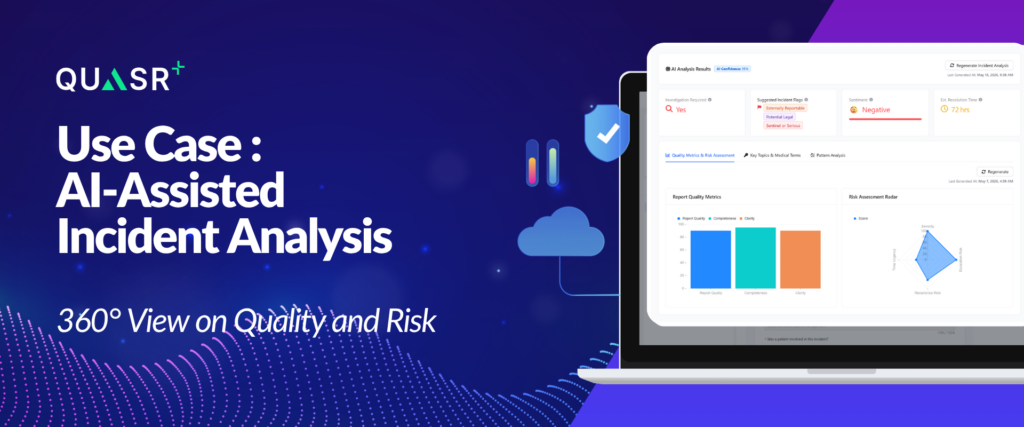
QUASR+ AI Incident Analysis is an intelligent decision-support tool. Using advanced AI and contextual analysis, the platform assists quality, clinical, and risk teams by generating structured insights for every incident report submitted.
The AI supports reviewers by helping identify potential risks, escalation indicators, reporting obligations, and recurring patterns. It is designed to strengthen review consistency and improve prioritisation – not replace human review or professional decision-making.
QUASR+ AI Incident Analysis provides guidance across several areas, including:
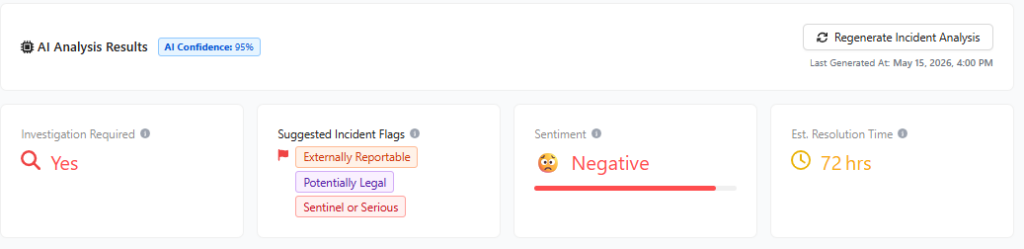
- Whether an investigation is required
- Incident flags for potential sentinel, sensitive, externally reportable, or potential legal/media exposure
- Sentiment analysis
- Estimated resolution time
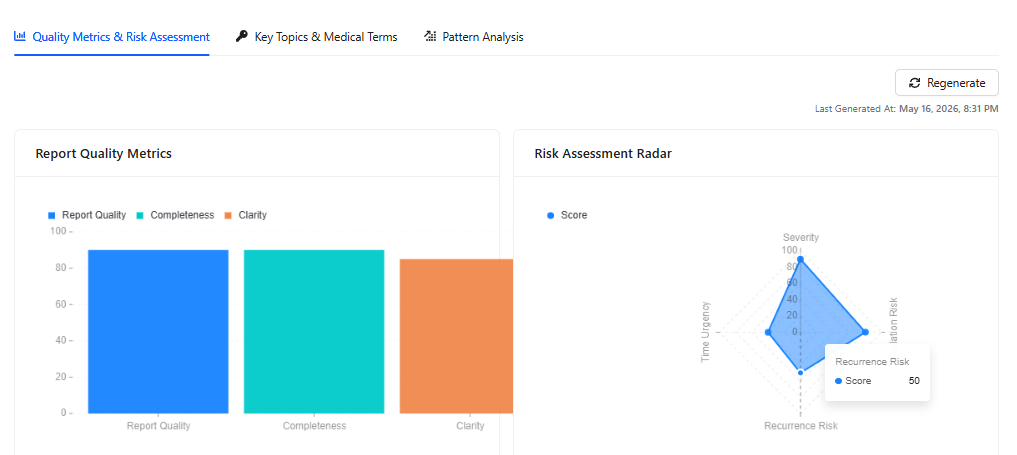
- Incident report quality metrics on data quality, completeness, and clarity
- Risk assessment indicators covering severity, escalation risk, recurring risk, and time urgency
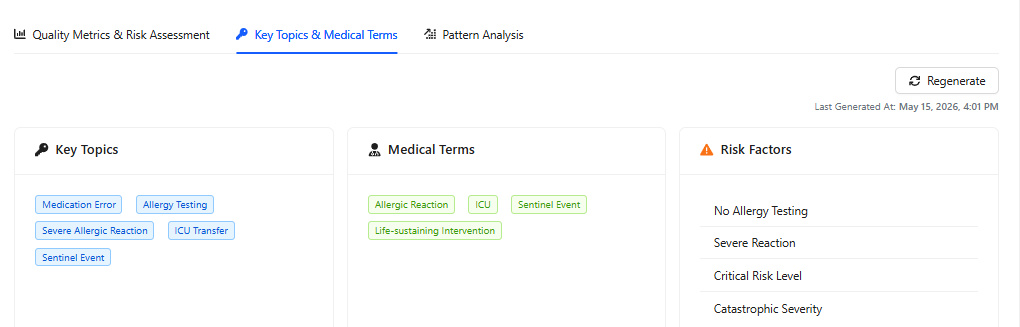
- Potential risk factors
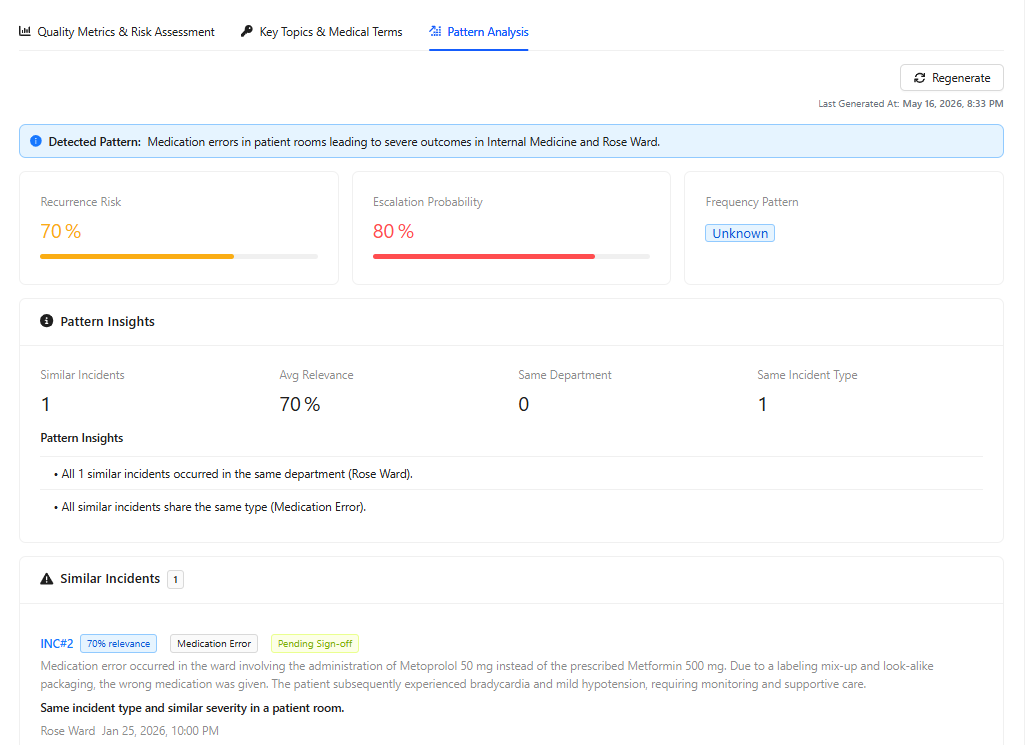
- Pattern analysis including similar incidents and recurring themes
AI Supports, Rather Than Replaces, Human Judgement
These AI-generated insights help organisations review incidents more efficiently while enabling quality and risk teams to focus attention on higher-risk cases.
Importantly, all AI outputs are suggestions in nature. QUASR+ AI Incident Analysis supports – but does not replace – professional judgement, clinical assessment, governance oversight, or organisational decision-making. Final responsibility for determining incident severity, approving escalation pathways, initiating investigations, assessing reportability obligations, and implementing corrective actions remains with Quality and Risk teams.
An AI confidence score reflects the AI model’s estimated level of confidence based on the information contained within the incident report and patterns identified from similar incidents. The confidence score is intended to support reviewer awareness and prioritisation only and should not be interpreted as a definitive determination or replacement for professional judgement.
AI analysis accuracy may vary depending on the quality, completeness, and consistency of incident data available within the system, as well as the volume of historical records and comparable incidents available for contextual analysis.
How QUASR+ Resolves the Problem
Supports More Consistent Incident Reviews
Incident assessments can vary between reviewers, teams, or service locations. Similar incidents may be interpreted differently depending on experience levels, workload pressures, or how information is documented.
QUASR+ helps standardise the review process by applying consistent analytical logic across all incident reports. The AI highlights potential escalation indicators, operational concerns, and compliance risks that may otherwise be overlooked during initial review.
For example, two staff members may describe a similar incident differently, but QUASR+ helps reviewers identify comparable underlying risk indicators, supporting more consistent and defensible review outcomes across the organisation. Reviewers retain full authority to validate, modify, or override all AI-generated recommendations.
Triggers Escalation and Investigation
Quality and risk teams often spend considerable time determining which incidents require urgent escalation or formal investigation. QUASR+ streamlines this process by automatically suggesting whether an investigation may be warranted and identifying incidents that may involve heightened safety, legal, regulatory, or reputational risks.
An incident involving injury, medication error, aggression, neglect, or absconding behaviour may trigger suggested flags such as sentinel, sensitive, potential legal/media exposure, or externally reportable.
This enables reviewers to prioritise higher-risk incidents earlier and reduce delays in escalation and response. While the AI supports prioritisation decisions, all escalation, investigation decisions and actions remain subject to professional review and clinical approval.
Improves Incident Report Quality
Incomplete or unclear incident reports can delay investigations and reduce the effectiveness of governance processes. QUASR+ helps improve reporting quality by evaluating data quality, completeness, and clarity.
These quality indicators help reviewers identify missing information or documentation gaps early in the review process, supporting faster follow-up and more effective investigations. The AI does not determine factual accuracy; instead, it assists reviewers by highlighting areas that may require clarification or further professional assessment.
Enhances Risk Visibility and Prioritisation
QUASR+ includes a Risk Assessment Radar that provides AI-assisted insights into severity, time urgency, escalation risk, and recurring risk. These indicators help organisations prioritise review activities and allocate investigative resources more effectively.
For example, two incidents may initially appear operationally similar, but one may present significantly higher reputational or escalation risk. QUASR+ helps reviewers identify these distinctions earlier, enabling more informed and timely decision-making.
Identifies Emerging Patterns and Systemic Risks
Traditional incident systems often focus on individual events, making it difficult to detect broader trends or recurring risks across the organisation.
QUASR+ AI Pattern Analysis helps identify recurring themes, escalation trends, and similar incidents across locations or services. Multiple low-level incidents occurring across different sites, for example, may indicate broader staffing, environmental, or process-related concerns before a major incident occurs.
These insights support proactive risk management, governance discussions, and continuous improvement initiatives while still requiring professional interpretation and organisational oversight.
Supports Compliance and Governance Oversight
Organisations operating in regulated environments must demonstrate timely escalation, effective governance, and appropriate reporting processes. QUASR+ assists organisations by identifying incidents that may warrant executive review, compliance escalation, legal assessment, or consideration for external reporting.
This strengthens governance oversight and helps reduce the likelihood of missed compliance obligations. Responsibility for determining reportability and regulatory actions, however, remains with authorised personnel and quality teams.
Key Benefits
QUASR+ AI Incident Analysis delivers significant operational and governance benefits, including:
- Improved consistency across reviewers and service locations
- Enhanced visibility into operational, clinical, legal, and reputational risks
- Better quality and completeness of incident reporting
- Reduced delays in investigations and escalation processes
- Stronger governance and compliance oversight
- Earlier identification of recurring risks and emerging patterns
- Improved allocation of quality and clinical review resources
Quality team can view all the indicators in a single page and regenerate the metrics based on the latest available information as required.
Strategic Impact
QUASR+ AI Incident Analysis transforms incident reporting from a passive documentation process into an intelligent platform, providing a 360o view on quality and risk exposure for all incidents.
By combining AI-assisted analysis with professional oversight, organisations can improve review consistency, strengthen safety and compliance outcomes, identify emerging risks earlier, and support more proactive operational governance.
Most importantly, QUASR+ preserves the central role of professional judgement while improving the speed, quality, and effectiveness of incident review processes. The result is a smarter, safer, and more scalable approach to incident management that supports continuous improvement and stronger organisational resilience.