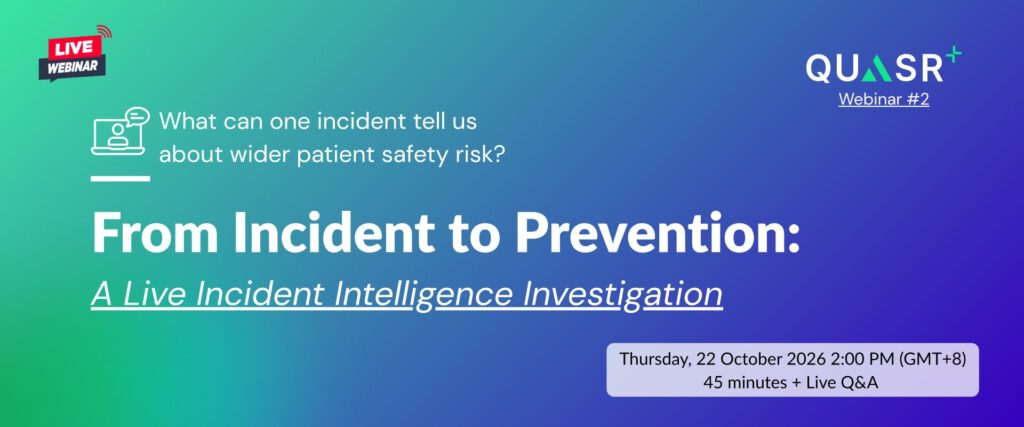
See how digital workflows, AI-assisted analysis and investigation tools can work together to turn one reported incident into learning, action and prevention.
Live Webinar | Presented by QUASR+
Thursday, 22 October 2026 | 2:00 PM (GMT+8) | 45 minutes + Live Q&A
What can one incident tell us about wider patient safety risk?
When an incident is reported, the immediate priority is to understand what happened and respond appropriately.
But the bigger questions often come later.
Has something similar happened before? Were there warning signs we missed? What contributed to the event? Is it an isolated incident – or part of a wider systemic risk? And if corrective actions have already been taken, how do we know whether they actually worked?
In this live webinar, we will start with one realistic medication incident and investigate it step by step using QUASR+.
Rather than a traditional software demonstration, we will follow the questions a Quality, Risk or Patient Safety team would naturally ask, and see where the incident data takes us.
Follow the Investigation
One incident. Four phases. A journey from reporting to prevention.
01 — UNDERSTAND
What happened—and what deserves our attention?
We begin with a newly reported medication incident and work through the initial review.
We will explore:
Which incidents need attention first?
See how AI-assisted triage can support prioritisation.
Can we understand the incident faster?
Follow the incident workflow and see how AI summarisation can reduce the burden of reviewing complex narrative information.
What should investigators pay attention to?
Explore how AI Incident Analysis can surface risk indicators, quality metrics, key topics and areas for further investigation.
QUASR+ in action: Incident Workflow · AI Triage · AI Summarisation · AI Incident Analysis
02 — INVESTIGATE
What lies behind the incident?
Now we move beyond the individual event and start investigating more deeply.
Has this happened before?
Use Similar Incident Analysis and AI Semantic Search to find related historical events—even when they were described or classified differently.
Were there warning signs before harm occurred?
See how Near Miss and No Harm events can become meaningful when viewed collectively.
How does the investigation team work together?
See how Notify Users, Discussion Topics and Incident Flags can support collaboration during an investigation.
Why did it happen?
Move from AI-assisted analysis to structured human investigation using digital 5 Whys and Fishbone RCA tools.
QUASR+ in action: AI Analysis (Detected Pattern, Similar Incidents, Risk Factors) · Semantic Search · Collaboration Tools · Digital RCA Tools
03 — LEARN
Is this one incident – or a wider organisational risk?
This is where the investigation begins to change perspective.
Instead of asking only what caused one incident, we look across related events to understand whether the same underlying conditions are appearing elsewhere.
What connects these incidents?
Explore how apparently different events can reveal a recurring systemic risk.
Haven’t we already tried to fix this?
Review previous interventions and corrective actions.
Were those actions strong enough?
Use Action Hierarchy to consider the difference between education, reminders and stronger system-level controls.
This leads to an important question:
Closing an action is not the same as reducing risk.
QUASR+ in action: Semantic Search · Pattern Recognition · Action Management · Action Hierarchy
04 — PREVENT
Did the intervention actually make a difference?
Finally, we move from learning to prevention.
We examine what happened after a stronger intervention was introduced and look for evidence that the control is working.
Did the stronger intervention work?
See an example where the risk was successfully intercepted before reaching the patient.
Has the underlying risk disappeared?
Consider why effectiveness needs to be monitored over time rather than assumed when an action is completed.
What should we change next?
Bring together incidents, weak signals, investigation findings and intervention outcomes to decide where stronger controls should be expanded or standardised.
The objective is not to predict exactly which patient will be harmed next.
It is to recognise when the conditions for harm are repeatedly appearing – and act before the next serious incident occurs.
QUASR+ in action: Action Effectiveness · Monitoring · Early Warning · Learning & Prevention
Live Webinar | Presented by QUASR+
Thursday, 22 October 2026 | 2:00 PM (GMT+8) | 45 minutes + Live Q&A
More Than an AI Demonstration
AI can help teams review information faster, connect related cases and surface patterns that deserve attention.
But AI does not replace patient safety professionals or make the final judgement.
This live investigation demonstrates how AI-assisted intelligence, digital incident workflows, collaboration, structured RCA, corrective actions and human judgement can work together across the incident lifecycle.
The goal is simple:
Help healthcare organisations learn more from the incident information they already collect – and turn that learning into safer care.
Who Should Attend?
Designed for healthcare leaders and professionals responsible for:
Patient Safety · Quality Management · Clinical Governance · Nursing · Risk Management · Compliance · Healthcare Technology
Particularly relevant for C-Suite Executives, Quality Directors, Patient Safety Leaders, Nursing Directors, Risk Managers, Clinical Governance Teams, CIOs and Heads of IT.
What You’ll Take Away
By the end of this live investigation, you will have seen how healthcare organisations can:
- Prioritise and review incidents more efficiently
- Use AI to make sense of complex incident narratives
- Find related events across large volumes of incident data
- Recognise Near Miss and No Harm events as potential early warning signals
- Combine AI-assisted analysis with structured RCA and human judgement
- Identify recurring and systemic risks across incidents
- Evaluate whether corrective actions are actually reducing risk
- Move from reactive incident management towards continuous learning and prevention
From Incident Reporting to Incident Intelligence
Incident reporting tells us what happened.
Investigation helps us understand why it happened.
Incident Intelligence helps us ask a bigger question:
What can we learn across our incident data to reduce the risk of it happening again?
Join us as we investigate one incident and follow the evidence from reporting to understanding, investigation, learning and prevention.
Thursday, 22 October 2026 | 2:00 PM (GMT+8) | 45 minutes + Live Q&A
Presented by QUASR+