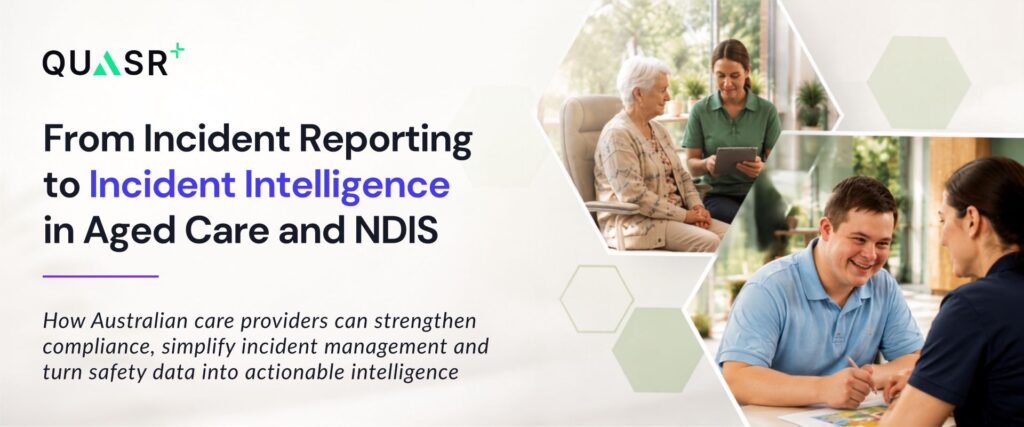
Why compliance alone is no longer enough, and how the right platform can simplify operations, strengthen governance and improve participant safety.
Delivering NDIS services is becoming increasingly complex.
Participant needs are more diverse, workforce pressures continue to challenge service delivery, and the expectations of the NDIS Quality and Safeguards Commission continue to evolve. For many small and medium-sized providers, the same people responsible for quality and compliance are also managing complaints, audits, policy reviews and day-to-day operational issues.
In this environment, an incident management system should do more than record what happened. It should help providers respond quickly, identify emerging risks, reduce administrative effort and continually improve the quality of supports.
Many providers already have a way to record incidents. The more important question is this: is your current system helping your organisation prevent harm, or simply helping you maintain records?
Compliance Is Only the Starting Point
The NDIS Practice Standards require registered providers to maintain an effective incident management system that identifies, assesses, manages and records incidents. Providers must also notify the NDIS Commission of reportable incidents within prescribed timeframes and demonstrate continuous improvement by learning from incidents and reducing the likelihood of recurrence.
These requirements are about much more than maintaining records. They are intended to help providers build safer services, strengthen governance and improve participant outcomes.
Yet many incident management systems were designed primarily for documentation. They capture information, produce reports and support audits, but offer limited assistance in recognising patterns, monitoring organisational risks or evaluating whether improvement initiatives are actually working. As providers grow, this creates an increasing administrative burden with quality teams spend more time processing incidents and less time learning from them.
Why Smaller NDIS Providers Feel the Pressure
Unlike larger organisations with dedicated quality departments, most small and medium-sized NDIS providers operate with lean teams. Quality managers, service managers and business owners often wear multiple hats, balancing incident management alongside compliance, workforce management, complaints and everyday operational demands.
As incident numbers grow, the limitations of traditional systems become increasingly apparent. Reports accumulate waiting for review, investigations vary depending on who conducts them, historical incidents are difficult to retrieve, and management reports provide little more than counts and categories. Corrective actions may be completed, but organisations often have limited visibility into whether they have reduced future risk.
The result is a significant administrative workload without a corresponding improvement in participant safety. Valuable time is spent managing incidents rather than understanding what they reveal about the organisation.
From Incident Reporting to Organisational Learning
An effective incident management system should do more than capture incidents – it should help organisations learn from them.
Every medication error, participant fall, behavioural incident or communication breakdown provides an opportunity to identify underlying risks before they become recurring problems. However, this is only possible when incidents can be analysed collectively rather than treated as isolated events.
Leading providers are therefore moving beyond traditional incident reporting towards Incident Intelligence – an approach that connects reporting, investigation, corrective actions, risk monitoring and continuous improvement into a single process. Instead of simply documenting what happened, providers gain the ability to identify trends, understand contributing factors and make better decisions that improve participant safety.
What Providers Should Expect from a Modern Platform
For many providers, replacing software sounds expensive, disruptive and time-consuming. Fortunately, modern cloud-based platforms are very different from the highly customised systems of the past.
Today’s providers should expect a solution that is practical, affordable and quick to implement. Rather than spending months configuring software, organisations should be able to start with proven incident forms, workflows and dashboards while retaining the flexibility to configure categories, approval processes, notifications and risk scoring to suit their own services and governance requirements. They can expect AI features that reduce staff workflow and provide incident intelligence.
Equally important, the platform should be intuitive for frontline workers and reduce the administrative burden on quality teams. Incident reporting should be straightforward, investigations should follow a structured process, and management information should be available without relying on spreadsheets or manual reporting.
In short, technology should simplify incident management, not become another project to manage.
How QUASR+ Supports NDIS Providers
QUASR+ was designed around these practical needs.
The platform enables providers to get started quickly using pre-configured incident forms, workflows and dashboards developed from healthcare and care-sector best practices, significantly reducing implementation time. At the same time, organisations retain the flexibility to configure workflows, incident categories, risk matrices and approval processes so the system reflects their own services rather than forcing them to change established practices.
This combination of rapid deployment and flexible configuration makes QUASR+ particularly well suited to smaller providers that need value from day one while retaining the ability to grow.
Beyond day-to-day reporting, QUASR+ supports the entire incident management lifecycle. Structured investigation workflows promote more consistent investigations; integrated corrective action management helps organisations monitor implementation and organisation-wide dashboards provide greater visibility into trends and emerging risks.
Where appropriate, organisations can also leverage capabilities such as AI-assisted incident triage, semantic search and risk analytics to prioritise incidents, locate similar historical cases and identify recurring patterns more efficiently. These capabilities enhance decision-making, but they are part of a broader platform designed to reduce administration, strengthen governance and support continuous improvement.
A Better Return on Your Quality Investment
For NDIS providers, every investment needs to deliver tangible operational value.
An effective incident management platform should reduce administration, simplify investigations, improve audit readiness and provide management with better visibility into organisational risks. It should also scale as the organisation grows, without requiring costly custom development or complex implementation projects.
Ultimately, the greatest value lies in helping providers prevent repeat incidents, improve participant safety and make better use of limited quality resources. When technology achieves these outcomes while supporting compliance, it becomes an investment in better service delivery rather than simply another operational expense.
Looking Beyond Compliance
The expectations placed on NDIS providers will continue to grow, particularly in participant safeguarding, governance and continuous improvement. Providers that rely solely on systems designed to record incidents may find it increasingly difficult to keep pace.
Forward-looking organisations are recognising that incident data is one of their most valuable sources of operational insight. By combining practical workflows, rapid implementation, flexible configuration and intelligent incident management within a single platform, QUASR+ helps providers spend less time administering incidents and more time improving participant safety and business operations.