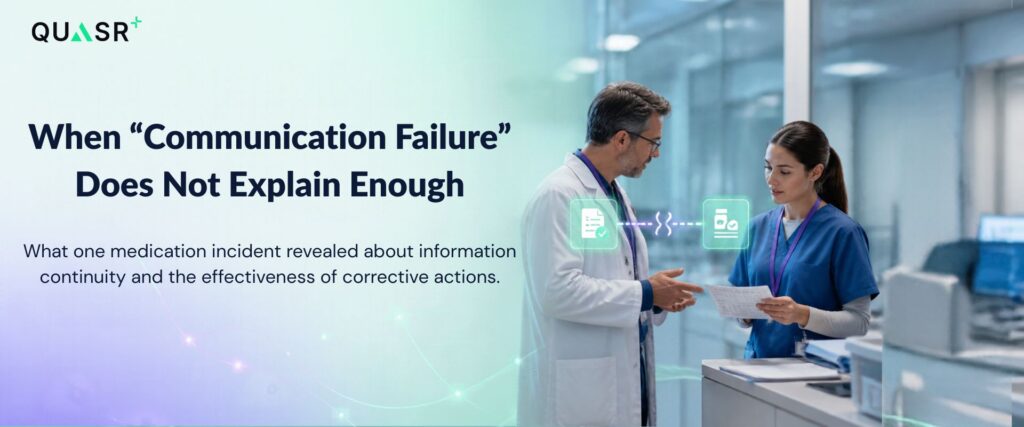
What one medication incident revealed about information continuity and the effectiveness of corrective actions
A decision to withhold a medication had been documented. The patient still received it. What had failed between the decision and the next dose?
That question opened our recent webinar, From Incident to Prevention: A Live Incident Intelligence Investigation. Using a synthetic medication incident and related fictional records, we explored how an investigation could move from understanding one event to examining a wider organisational risk.
In our earlier article, we asked what one incident could tell us about patient safety beyond the individual event. The investigation made that question concrete. It revealed a recurring gap between information being recorded and that information reaching the person or workflow that needed to act on it.
A documented decision did not reach the point of action
The case involved a patient who received metoprolol despite an earlier decision to withhold it. The patient subsequently developed hypotension and bradycardia and required monitoring.
The initial investigation identified a mismatch. The decision was documented, but the active medication order had not been updated. The change had not been reliably transferred and acknowledged during the shift transition.
Calling this a communication or handover failure described part of what happened. It still left important questions unanswered. Why could a documented decision coexist with an active order that instructed someone to do something different? What would ensure the incoming nurse received and acted on the change?
Those questions directed attention towards the process connecting the clinical decision, medication record and next person responsible for care.
Related events changed the scope of the investigation
We then examined potentially related incidents. Some involved different medicines, departments or types of error. Their narratives described order discrepancies, uncertainty about previous administration and medication changes during transitions.
Searching by meaning helped identify records worth reviewing, even when they used different words. Each connection still needed investigation. Two medication errors can have different causes, while events in different categories may share an underlying weakness.
Across the relevant fictional cases, a recurring mechanism emerged. A medication decision or administration event occurred, but the latest information did not reliably reach the next person or workflow step. The active order, administration history and handover information could fall out of sync.
This pointed to a wider information-continuity risk during transitions of care. It also changed the scope of the investigation. Alongside asking why this patient received this dose, we now needed to ask where else the same conditions appeared.
Earlier events revealed vulnerabilities and safeguards
Near Miss and No Harm records added another perspective. In some cases, staff identified discrepancies or checked administration records before an error reached the patient. In another, a medication-change alert and acknowledgement helped ensure a dose was withheld.
These records raised two useful questions. Where did the process depend on someone noticing and resolving a discrepancy? Where did a defined control help the right information reach the right person?
The distinction matters for learning. An intercepted event can reveal a vulnerability and provide evidence about the safeguard that caught it. Reviewing the circumstances helps investigators understand both the exposure and the protection available.
Within this scenario, earlier events offered opportunities to recognise recurring conditions for harm. They did not establish that a particular future incident could have been predicted.
Completed actions had left an unresolved question
The investigation also returned to earlier corrective actions. The fictional history included education, reminders, reconciliation controls and handover improvements. Some actions had been completed, yet related signals continued.
This prompted a difficult question: what had those actions changed about the failure mechanism?
A reminder might reinforce the need to communicate medication changes. The investigation still needed to establish how a change would update the active record, remain visible during transition and be acknowledged by the receiving person.
The response therefore needed to address the specific breaks identified in the process. For this scenario, that meant considering a more reliable medication-change process and defining how its operation would be checked.
Closing an action is not the same as reducing risk. Completion records show that work was carried out. Effectiveness requires evidence about what happened afterwards.
A successful interception showed what to examine next
One fictional record provided a useful contrast. An insulin hold triggered a medication-change alert during a closed-loop pilot. At handover, the incoming nurse acknowledged the change and confirmed that the evening dose should not be administered. The potential error was intercepted.
Here, the record showed an explicit connection between the medication change and acknowledgement by the next person responsible. It illustrated how the control could work.
One successful interception could not establish that the wider risk had been resolved. The next step would be to monitor whether relevant changes were consistently reflected in active orders and acknowledged during transitions, alongside reviewing further discrepancies and related incidents.
The evaluation would also need to consider whether the revised process introduced delays or other problems. The aim would be to build a picture of control performance over time, using incident information together with checks on how the process operated.
AI helped investigators find and examine the evidence
During the webinar, we used QUASR+ to bring incident information together, search for potentially related events and examine previous actions. AI supported summarisation and discovery. Digital workflows, collaboration and RCA tools helped structure the investigation.
The reasoning remained investigator-led. Suggested similarities required review against the original records. Patterns prompted questions, and the team examined contributing factors before drawing conclusions.
The learning came from connecting those activities across the incident lifecycle and continuing to ask what the evidence justified.
Five questions for your next investigation
Quality and Patient Safety teams can use the same line of enquiry when reviewing an incident:
- What information failed to reach the next person or workflow step?
- Where else might the same mechanism appear, including under different incident categories?
- What do Near Miss and No Harm events reveal about vulnerabilities and successful safeguards?
- What actions have already been taken, and why might related events continue?
- What evidence would show that the revised control is working consistently?
Our investigation began with one medication incident. Following the evidence expanded the enquiry to information continuity, earlier interventions and the performance of safeguards. That is the practical value of Incident Intelligence: using individual events to ask better questions about wider risk, then carrying the learning through to action and ongoing review.
Watch the investigation on demand
Watch From Incident to Prevention: A Live Incident Intelligence Investigation to follow the synthetic case through incident review, related-event analysis, RCA and action-effectiveness assessment.
Start Your Free Trial Today and Experience AI Incident Intelligence with QUASR+
Related article: What Can One Incident Tell Us About Wider Patient Safety Risk?