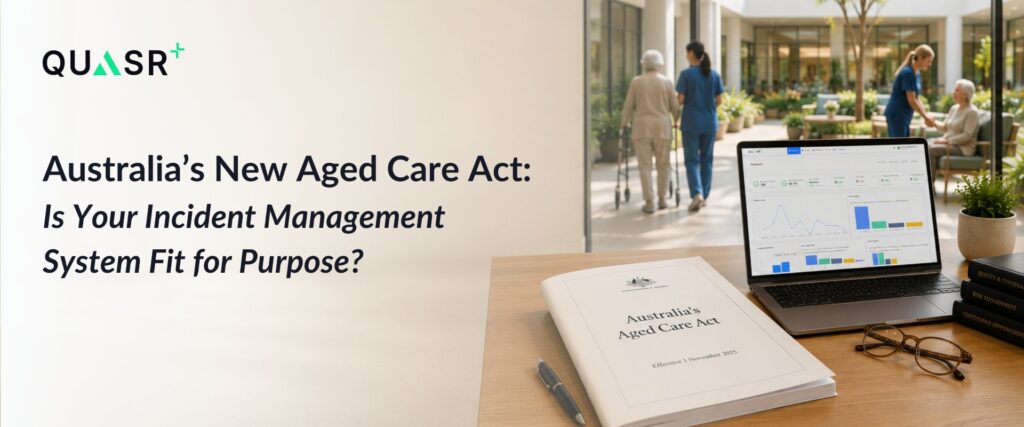
Australia’s Aged Care Act 2024, in effect since 1 November 2025, places greater emphasis on the rights, safety and wellbeing of older people. Together with the strengthened Quality Standards and Serious Incident Response Scheme (SIRS), it raises expectations for how providers identify risks, manage incidents, demonstrate accountability and improve care.
For aged care providers, the challenge is no longer simply to record what happened. They must show that incidents are reported promptly, assessed consistently, investigated properly, acted upon and used to prevent recurrence.
That puts the effectiveness of the incident management system under greater scrutiny.
Why compliance may be harder than it looks
Many providers already have incident reporting processes in place. The difficulty is that these processes may rely on spreadsheets, paper forms, email follow-ups or systems designed mainly for recordkeeping.
As regulatory expectations increase, these limitations post new challenges.
Providers may struggle with:
- incomplete or inconsistent incident reports;
- delays in triage, escalation and regulatory notification;
- large backlogs of incidents awaiting review;
- fragmented records across facilities or service teams;
- inconsistent investigations and root cause analysis;
- corrective actions tracked outside the incident system;
- limited evidence that actions reduced risk; and
- poor visibility of recurring incidents and emerging trends.
In addition, providers may encounter delays in notifying Aged Care Quality and Safety Commission (ACQSC) on serious events.
These challenges are not simply administrative inefficiencies – they can delay intervention, weaken governance, and lead to non-compliance.
A system that captures reports but does not support timely decisions, accountable action and organisational learning may no longer be fit for purpose.
What providers now need from incident management
A modern incident management system should support the full lifecycle of an incident, from reporting and triage through investigation, action, monitoring and learning.
- Easier, more consistent reporting
Frontline staff should be able to report incidents and near misses quickly, without navigating lengthy or confusing forms. Configurable fields and workflows help ensure the right information is captured across different services and locations. The objective is not to collect more data. It is to collect useful data that supports action.
- Faster triage and escalation
High-risk incidents must be identified early and directed to the right people. Consistent risk assessment, automated notifications and escalation workflows help prevent serious events from being overlooked in a growing queue of reports. This is especially important where quality teams are managing high volumes across multiple facilities.
- Stronger investigations
Investigations should do more than document the event. They should identify contributing factors, system weaknesses and the changes required to reduce future risk. Structured investigation and root cause analysis tools can improve consistency, preserve evidence and create a clear audit trail.
- Accountable corrective actions
Actions should be assigned, monitored and reviewed within the same system. Providers need visibility of overdue tasks, responsible owners and whether completed actions were effective. Closing an action is not the same as controlling the risk.
- Clearer oversight and learning
Leaders and governing bodies need more than incident counts. They need to understand where risks are increasing, which events are recurring and where intervention is required. That requires consolidated visibility across facilities, incident types, risk levels and corrective actions.
From compliance to incident intelligence
Compliance requires providers to maintain appropriate systems, respond to incidents and demonstrate accountability. Incident intelligence goes further by transforming safety data into actionable insights, and insights into prevention using the power of AI.
Instead of reviewing each report in isolation, providers can examine relationships across incidents and near misses. For example:
- Are falls increasing during particular shifts or in certain locations?
- Are medication incidents associated with handovers or changes in resident care?
- Are similar incidents occurring across several facilities?
- Have previous corrective actions reduced recurrence?
These questions cannot be answered reliably through individual reports alone. They require structured data, connected workflows and the ability to detect patterns and hidden trends across time.
The value of an incident management system should therefore be measured not only by how efficiently it records incidents, but also by how effectively it helps the organisation anticipate and reduce harm.
How QUASR+ supports aged care providers
QUASR+ is an AI-powered incident management and intelligence platform designed for healthcare and care settings, including aged care services and nursing homes.
It brings reporting, triage, investigation, corrective action and analysis into one configurable platform, helping providers strengthen compliance while improving how they identify and manage risk.
With QUASR+, providers can:
- configure incident forms, categories, workflows and risk assessment methods;
- flag serious incidents and alert senior management;
- use AI-assisted triage to prioritise high-risk events;
- generate concise AI incident summaries for faster review;
- conduct structured investigations and root cause analysis;
- assign, escalate and monitor corrective actions;
- search previous incidents using natural-language semantic search;
- detect recurring patterns and emerging risk signals; and
- provide management and governing bodies with clearer oversight.
For example, a quality manager could search for incidents involving confusion due to medication changes, even where different staff used different wording to describe such incidents. Across multiple facilities, QUASR+ can help surface repeated patterns that may otherwise remain hidden within individual reports.
AI supports this process using natural language processing and anomaly detection, highlighting possible risks and making relevant evidence easier to find. It does not replace professional judgement. Decisions remain with the quality and governance teams.
Turn Compliance into Continuous Improvement
The new Aged Care Act creates a stronger framework for rights-based, safe and high-quality aged care. Meeting its requirements depends not only on policies and procedures, but also on whether providers can translate incidents into timely action and sustained improvement.
A fit-for-purpose incident management system should help an organisation demonstrate what happened, how it responded and what it changed. More importantly, it should help identify risks before they lead to further harm.
QUASR+ enables aged care providers to move beyond fragmented reporting and reactive case management. By combining configurable incident forms and workflows with AI-powered incident intelligence, it helps providers gather all relevant data, identify incident patterns, recognise early warning signals, and prevent recurrence.
The goal is not only to ensure compliance. It is also to learn more from every report – and use that learning to prevent harm and improve care quality.