The Case for Moving Beyond Reporting to AI-powered Incident Intelligence
Every healthcare organisation encourages staff to report incidents. Hundreds of reports are submitted each year covering patient falls, medication errors, near misses, equipment failures, workplace injuries, and communication breakdowns. Reporting rates are often viewed as an indicator of a strong safety culture, and many organisations have invested in digital reporting systems to streamline the process.
Yet an important question remains:
“Is your incident reporting system helping your organisation learn, or merely collecting reports?”
For many healthcare providers, incident reporting has become an administrative and compliance process. Staff submit reports, managers review them, investigations are completed, corrective actions are assigned, and the reports are archived. Compliance requirements are met, but valuable knowledge often remains locked within individual records. Similar incidents continue to recur, investigations consume significant resources, and opportunities for organisational learning are missed.
The purpose of incident reporting has never been to create a database of events. Its purpose is to improve patient safety by enabling organisations to identify risks, understand why incidents occur, and prevent them from happening again. The WHO, the Agency for Healthcare Research and Quality (AHRQ), ISQua and Joint Commission International (JCI) all emphasize that reporting systems should support learning and continuous improvement rather than simply documenting adverse events.
The challenge is that traditional reporting systems were designed to capture incidents, not to generate insights.
When Reporting Stops at Documentation
Most healthcare organisations are not short of incident data – they are short of actionable intelligence.
Quality and patient safety teams often spend countless hours reading lengthy narratives, categorising incidents, assigning risk levels, preparing investigation summaries and tracking corrective actions. As reporting volumes increase, it becomes increasingly difficult to identify recurring patterns, emerging risks or systemic issues across departments and facilities.
As a result:
- Similar incidents are investigated repeatedly instead of being prevented.
- Early warning signals remain hidden among hundreds of reports.
- Lessons learned in one department are not shared across the organisation.
- Safety teams spend more time processing reports than improving care.
Collecting more reports does not automatically make healthcare safer. Organisations become safer when they learn from incident reports and take actions to prevent recurrence.
From Incident Reporting to Incident Intelligence
Leading healthcare organisations are rethinking the role of incident reporting. Rather than treating each report as an isolated event, they use every incident as a source of organisational learning.
Instead of asking “What happened?”, they ask:
- Have we seen similar incidents before?
- Is this becoming an emerging trend?
- What are the common contributing factors?
- Which corrective actions have proven effective?
- Where should we intervene before another incident occurs?
Answering these questions requires more than an online reporting form. It requires incident intelligence – the ability to transform large volumes of incident data into meaningful insights that support earlier risk detection, faster decision, and effective intervention.
This shift from reactive documentation to proactive prevention is becoming one of the defining characteristics of modern patient safety programmes.
How AI Accelerates Organisational Learning
Artificial intelligence is transforming incident reporting by helping healthcare organisations extract value from data that would otherwise remain hidden. Rather than replacing clinical or managerial judgement, AI reduces administrative effort and helps reviewers identify important signals more quickly and consistently.
Within QUASR+, AI capabilities are embedded throughout the incident management lifecycle to support quality and patient safety teams.
AI Incident Summarization converts lengthy narratives into concise, structured summaries, allowing reviewers to understand incidents quickly without reading multiple pages of free text.
AI Incident Triage assists reviewers by recommending incident priority and escalation path based on risk ratings, while keeping final decisions firmly under human control.
AI Semantic Search enables investigators to locate similar historical incidents using meaning rather than exact keywords, making it far easier to identify recurring risks and learn from previous cases.
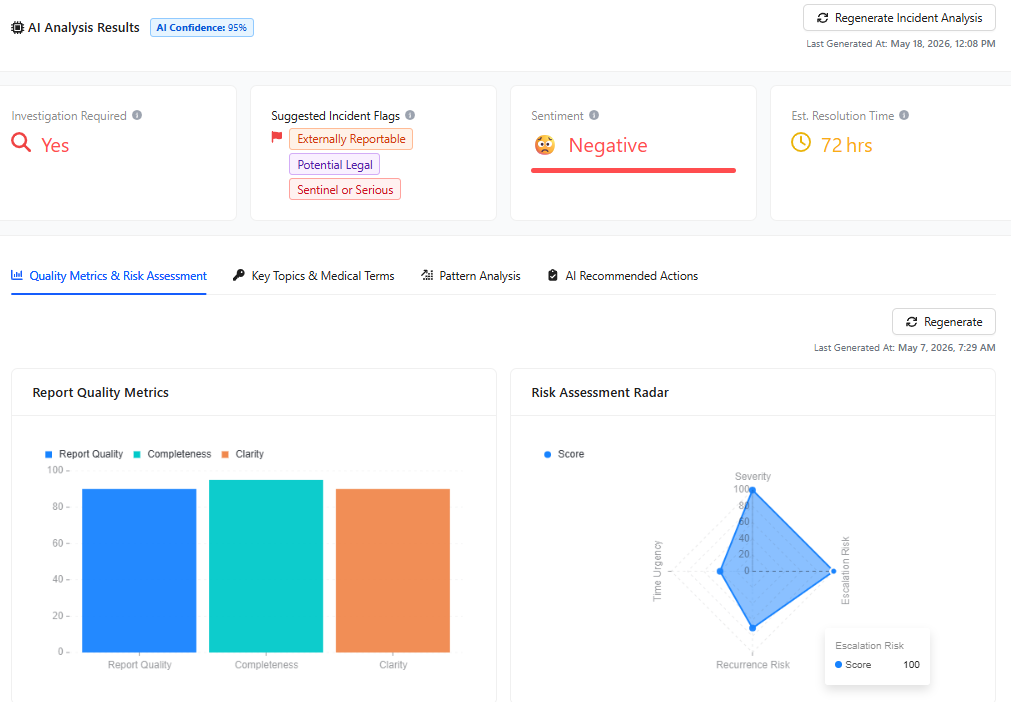
AI Incident Intelligence continuously analyses incident data to surface trends, recurring contributing factors and emerging safety risks that may not be apparent when incidents are reviewed individually.
Together, these capabilities reduce manual effort while helping organisations learn faster from every reported event.
How QUASR+ Helps Organisations Learn from Every Incident
QUASR+ was designed around a simple belief:
Every incident should contribute to preventing the next one.
More than an online incident reporting system, QUASR+ combines configurable forms and workflows, AI-powered analysis and real-time risk intelligence to support the complete incident management lifecycle – from reporting and triage through investigation, corrective actions, monitoring and organisational learning.
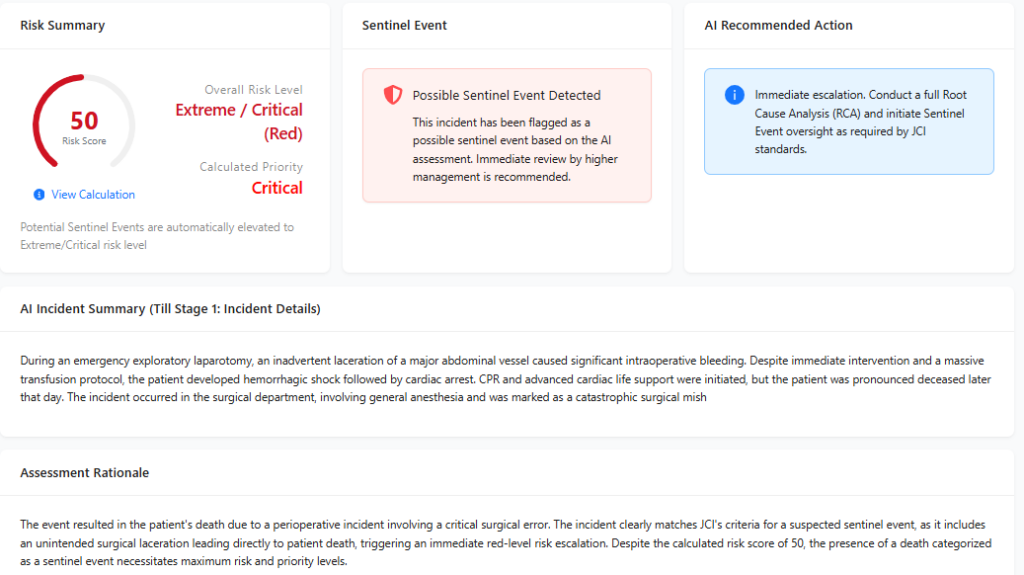
Healthcare organisations can configure incident forms, workflows, and risk assessment models to align with their governance frameworks, while interactive dashboards provide leadership with real-time visibility into incident trends, investigation status and operational risk.
By combining structured workflows with AI-assisted analysis, QUASR+ helps quality teams spend less time managing reports and more time improving patient safety.
AI That Supports, Not Replaces, Human Judgement
The adoption of AI in healthcare must always be guided by responsible governance. QUASR+ is designed on the principle that AI should augment – not replace – human expertise.
AI provides recommendations, identifies patterns and accelerates analysis, while clinicians, investigators and quality professionals remain responsible for reviewing evidence, making decisions and determining appropriate actions. This human-in-the-loop approach ensures that AI enhances consistency, efficiency and learning while maintaining transparency, accountability and trust.
Is Your Incident Reporting System Helping You Learn?
As healthcare becomes more complex, simply digitizing paper forms is no longer enough. Organisations need systems that not only record what happened, but also reveal why it happened, where similar risks exist, and how future harm can be prevented.
If your current system cannot:
- identify recurring incidents across the organisation,
- prioritise risks consistently,
- uncover emerging safety trends,
- reduce investigation effort through AI, or
- transform incident data into actionable intelligence,
then it may be helping you collect reports – but not helping you learn quick enough to prevent harm.
Experience the Difference with QUASR+
The future of patient safety belongs to organisations that learn faster than risks emerge. Incident reporting is no longer just about documenting events – it is about turning every incident into an opportunity to prevent harm and improve care quality.
QUASR+ combines modern incident reporting with AI-powered incident intelligence to help healthcare organisations move beyond compliance towards continuous learning, proactive risk management and safer patient outcomes.