Healthcare organisations today face increasing pressure to improve patient safety, strengthen governance, and respond faster to emerging risks. Yet despite decades of progress in clinical quality improvement, many hospitals and healthcare systems still rely on outdated incident reporting processes that limit learning, delay corrective action, and contribute to underreporting.
Research from various leading patient safety institutions consistently shows that ineffective incident reporting systems undermine organisational learning and patient outcomes.
At QUASR+, we believe incident reporting should not merely document what went wrong – it should become a strategic engine for prevention, continuous learning, and proactive risk management.
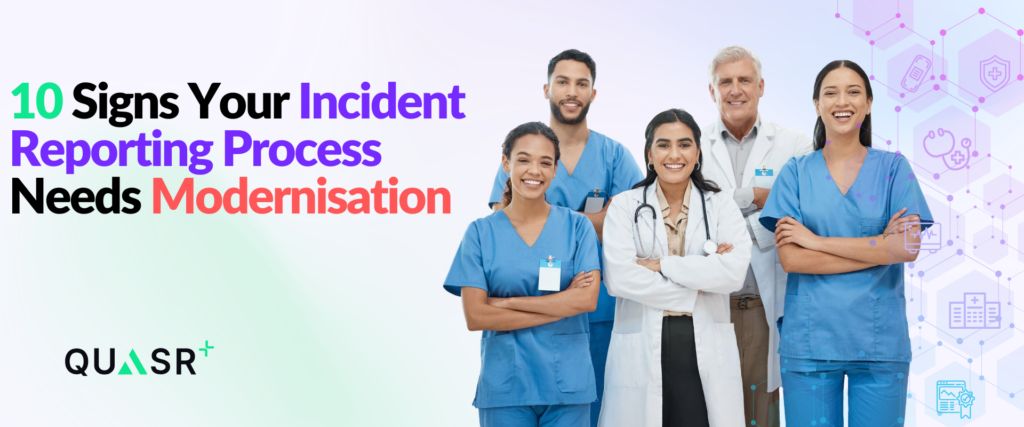
Here are 10 evidence-based warning signs that your incident reporting process may be outdated.
1. Staff Are Reluctant to Report Incidents
One of the clearest indicators of a failing reporting culture is low staff engagement.
Multiple studies have shown that healthcare workers often avoid reporting incidents due to:
- Fear of blame
- Lack of feedback
- Complex reporting systems
- Perception that reporting does not lead to improvement
A recent NHS study found that incident reporting systems remain “underutilised” because of both cultural and operational barriers. Similarly, research has shown that organisations with a stronger “Just Culture” significantly improved staff willingness to report near misses and safety concerns. If staff see reporting as punitive or burdensome, valuable safety intelligence is lost before leadership ever sees it.
Digital platforms can dramatically reduce this friction by simplifying reporting workflows and improving transparency around follow-up actions.
2. Near Misses Rarely Get Reported
Near misses are among the most valuable sources of patient safety learning because they reveal system vulnerabilities before patient harm occurs. Yet research consistently shows they are heavily underreported.
AHRQ’s Patient Safety Network highlights that near misses are “not frequently reported” despite their importance for organisational learning. Studies published in the International Journal for Quality in Health Care further found strong correlations between patient safety culture and nurses’ intention to report near misses.
Organisations that fail to capture near misses are often operating reactively – learning only after harm occurs.
Modern digital reporting systems make near-miss reporting easier through:
- Mobile accessibility
- Anonymous reporting options
- Simplified workflows
- Automated feedback loops
3. Incident Data Is Fragmented Across Multiple Systems
If incidents are managed through paper forms, spreadsheets, emails, or disconnected databases, the organisation likely lacks a reliable “single source of truth.”
WHO guidance on patient safety reporting emphasizes that incident reporting systems must support organisational learning and actionable insight – not just data collection.
Fragmented systems commonly result in:
- Duplicate records
- Missing information
- Poor visibility
- Delayed investigations
- Weak trend analysis
Healthcare organisations increasingly require centralised platforms that integrate reporting, investigation, corrective action tracking, analytics, and governance into one ecosystem.
4. Investigations and Follow-Ups Take Too Long
Delayed investigations reduce the ability to prevent repeat incidents and expose organisations to compliance and reputational risks.
A BMJ Quality Improvement study examining NHS serious incident reporting found that some investigations exceeded 200 days before process improvements were introduced. The study identified recurring operational challenges including:
- Workflow inefficiencies
- Resource constraints
- Communication gaps
- Lack of accountability
- Technology limitations
Speed matters in patient safety. Healthcare organisations need automated workflows that accelerate case assignment, escalation, notifications, investigation tracking, and corrective action monitoring.
5. Leadership Lacks Real-Time Visibility Into Risks
Many healthcare organisations still depend on static monthly reports or manual audits to identify safety concerns. By the time leadership reviews the data, the risk may already have escalated.
NHS England’s Patient Safety Incident Response Framework (PSIRF) emphasizes the need for organisations to develop effective systems for learning and continuous safety improvement.
Without real-time visibility, leaders struggle to:
- Detect emerging trends
- Prioritise interventions
- Allocate resources effectively
- Measure corrective action effectiveness
Modern digital platforms provide live dashboards, risk heatmaps, and predictive analytics that support faster and more informed decision-making.
6. Root Cause Analyses Are Inconsistent
Inconsistent investigations create inconsistent learning. Research in BMJ Open Quality found that variations in reporting practices and limited understanding of reporting system functionalities reduce the effectiveness of patient safety programmes.
Organisations often face challenges such as:
- Different departments using different RCA methods
- Incomplete investigations
- Weak corrective actions
- Lack of standardized documentation
- Lack of resources and expertise
Digital governance systems standardise methodologies, workflows, templates, and escalation protocols – improving consistency and accountability organisation-wide.
7. Your Organisation Struggles to Identify Trends
One of the greatest limitations of manual reporting systems is the inability to convert data into actionable insights.
If leadership cannot quickly identify recurring medication errors, high-risk departments, common contributing factors, and escalating incident patterns, then the organisation is collecting data without extracting meaningful insight.
This is where AI becomes transformational. AI-powered incident management systems can help organisations:
- Detect hidden risk patterns
- Prioritise high-risk events
- Identify recurring root causes
- Automate categorisation (with human oversight)
- Predict emerging issues
Healthcare is moving from reactive reporting toward predictive patient safety management.
8. Corrective Actions Are Poorly Tracked
A recurring industry problem is that organisations document corrective actions but fail to ensure completion or effectiveness. Learning and follow-through are critical components of incident management systems.
Common warning signs include:
- Overdue actions
- No ownership assignment
- Lack of verification
- Repeat incidents despite interventions
Digital systems improve accountability by automating action tracking, reminders, escalations, audit trails, and outcome monitoring.
9. Compliance Reporting Requires Manual Effort
If preparing accreditation or regulatory reports still requires extensive manual consolidation, the reporting process is likely outdated.
Healthcare organisations face growing compliance demands across:
- Accreditation standards
- Patient safety frameworks
- Governance reporting
- National reporting obligations
Manual processes increase administrative burden, human error, inconsistent reporting, and audit risk. Centralized digital platforms improve compliance readiness through structured data capture, standardised reporting, and automated documentation.
10. Focusing on Documentation Instead of Prevention
Perhaps the most important warning sign of all is when incident reporting becomes a “tick-box exercise” rather than a driver of safety improvement.
A landmark article in BMJ Quality & Safety argued that healthcare incident reporting systems have often failed to achieve their original ambitions because organisations focus more on collecting reports than learning from them.
Modern patient safety programmes must move beyond retrospective documentation toward:
- Real-time intelligence
- Proactive intervention
- Continuous organisational learning and improvement
- Predictive risk management
This requires not only digitalisation, but intelligent digitalisation powered by AI.
Why Healthcare Must Move Toward Digitalisation and AI
Healthcare systems worldwide are recognising that traditional incident reporting processes are no longer sufficient for modern patient safety demands.
Digital transformation is enabling healthcare organisations to:
- Improve reporting participation
- Accelerate investigations
- Strengthen governance
- Enhance transparency
- Generate predictive insights
- Build stronger safety cultures
AI further enhances this transformation by helping organisations identify patterns and risks that humans alone may overlook.
At QUASR+, we believe the future of patient safety lies in intelligent, connected, and proactive incident management systems that empower both frontline staff and leadership teams. The platform is designed to help healthcare organisations strengthen patient safety culture through digital workflows, centralized oversight, and AI-powered insights.
By modernising incident reporting and learning systems, healthcare providers can move beyond reactive compliance toward proactive, data-driven patient safety transformation.