In healthcare, identifying what went wrong is only half the battle. The real challenge is ensuring the same incident does not happen again.
This is where Action Hierarchy becomes one of the most important concepts in patient safety.
At QUASR+, we believe incident reporting should not stop at documentation. It should drive meaningful, system-level improvement that reduces harm, strengthens accountability, and builds a proactive culture of safety. As highlighted across the QUASR+ patient safety thought leadership series, modern healthcare organisations need smarter ways to move from reactive reporting to proactive prevention.
Action Hierarchy helps organisations do exactly that.
What Is Action Hierarchy?
Action Hierarchy is a framework used in patient safety and Root Cause Analysis (RCA) to evaluate the strength and effectiveness of corrective actions after an incident occurs.
The framework became widely adopted through the RCA2 (Root Cause Analysis and Actions) methodology developed by the National Patient Safety Foundation and the Institute for Healthcare Improvement (IHI). IHI describes Action Hierarchy as a tool that helps healthcare teams identify “which actions will have the strongest effect for successful and sustained system improvement.”
The hierarchy categorises actions into three broad levels:
1. Strong Actions
These interventions are considered the most effective because they reduce reliance on human memory, vigilance, or perfect behaviour. Examples include:
- Automation
- Forcing functions
- Standardisation
- Simplification
- Engineering controls
- System redesign
Strong actions make it harder to make mistakes. Examples in healthcare include:
- Barcode medication administration
- Automated allergy alerts
- Smart infusion pumps
- Standardised surgical trays
- Electronic prescribing safeguards
The Department of Veterans Affairs (VA) National Center for Patient Safety – one of the pioneers in modern patient safety systems – originally developed many of the concepts underlying the Action Hierarchy framework.
Research published in the International Journal for Quality in Health Care explains that strong corrective actions improve patient safety by either preventing active failures or reducing their consequences when they occur.
2. Intermediate Actions
Intermediate actions reduce risk but still depend partially on human compliance. Examples include:
- Checklists
- Standardised communication tools
- Clinical decision support prompts
- Independent double checks
- Structured handoff protocols
These interventions can significantly improve reliability, but their effectiveness may decrease over time if staff experience fatigue, workload pressure, or alert fatigue.
The IHI recommends that healthcare organisations implement at least one strong or intermediate action for key contributing factors identified during investigations.
3. Weak Actions
Weak actions are the least reliable because they rely heavily on people remembering to do the right thing consistently. Examples include:
- Retraining staff
- Sending reminder emails
- Updating policies
- Posting warning signs
- Conducting awareness campaigns
While education remains important, evidence from patient safety literature consistently shows that training alone rarely prevents recurrence of safety events. As the RCA2 guidance emphasizes prevention of future harm requires action.
This is why leading safety organisations caution against over-reliance on administrative or educational fixes without accompanying system redesign.
Why Action Hierarchy Matters in Patient Safety
1. Because Human Error Is Inevitable
Healthcare environments are complex, fast-moving, and high pressure. Even highly skilled clinicians can make mistakes under stress, interruptions, fatigue, or cognitive overload.
Weak actions assume humans will perform perfectly every time. Strong actions assume humans are human. This distinction is central to modern patient safety science.
The VA National Center for Patient Safety and IHI both emphasize that investigations should focus on identifying system vulnerabilities rather than blaming individuals.
James Reason’s widely respected systems-based safety theory similarly argues that adverse events occur when organisational weaknesses align across multiple layers of defence.
Action Hierarchy operationalises this philosophy by encouraging healthcare organisations to prioritise system-level improvements over person-focused interventions.
2. Because Many RCAs Fail to Create Sustainable Change
One of the most common criticisms of traditional RCA is that investigations often conclude with staff re-education, policy reminders, and additional training.
These actions are relatively easy to implement but often ineffective long term. The RCA2 framework was specifically created because many healthcare investigations historically failed to produce measurable, sustainable improvement.
The Joint Commission Journal on Quality and Patient Safety recently reinforced the importance of intervention strength by studying corrective actions through the VA/IHI Action Hierarchy model.
Without stronger interventions, organisations risk repeating the same incidents despite multiple investigations.
3. Because Stronger Actions Reduce Repeat Incidents
Human factors research consistently demonstrates that system-focused interventions are more effective than person-dependent interventions.
The International Journal for Quality in Health Care notes that forcing functions and standardisation are among the strongest approaches because they reduce opportunities for failure at the system level.
For example:
| Weak Action | Stronger Alternative |
|---|---|
| Remind staff to verify patient identity | Barcode patient identification |
| Retrain staff on medication handling | Smart dispensing systems with safeguards |
| Send memo about falls prevention | Bed exit alarms with automated escalation |
| Educate staff about hand hygiene | Workflow redesign with automated monitoring |
Strong actions reduce dependence on memory, vigilance, and individual perfection. That is why mature patient safety organisations increasingly prioritise engineering and system redesign approaches.
How QUASR+ Supports Better Action Hierarchy Practices
At QUASR+, we believe patient safety technology should help organisations move beyond passive reporting into active prevention. Traditional incident systems often become repositories of documentation rather than engines for improvement.
QUASR+ was designed differently.
Intelligent Incident Analysis
QUASR+ helps healthcare teams identify patterns, contributing factors, and risk trends faster through AI-powered analysis and structured workflows.
This allows organisations to:
- Detect recurring system vulnerabilities
- Prioritise high-risk issues
- Improve consistency in investigations
- Support stronger corrective action planning
- Strengthen governance and accountability
Rather than simply capturing incidents, QUASR+ helps organisations learn from them.
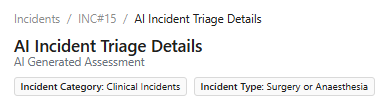
QUASR+ AI-Assisted Incident Analysis recommends actions using the Action Hierarchy framework. Below is a sample QUASR+ screenshot for a Surgical or Anaesthesia incident type.
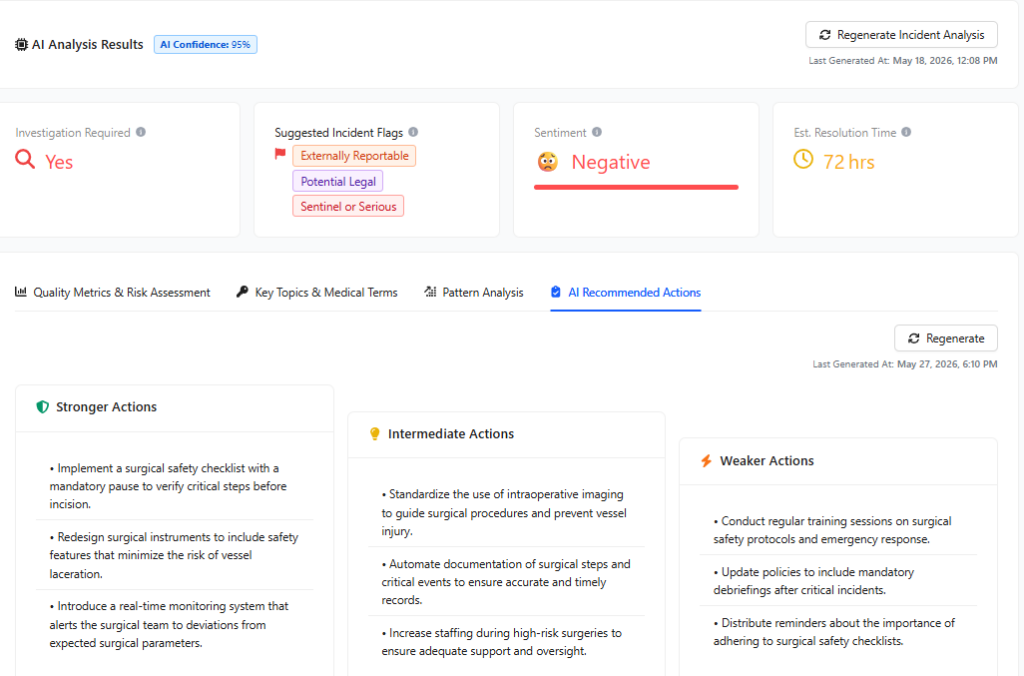
QUASR+ AI Incident Analysis is an intelligent decision-support tool. Using advanced AI and contextual analysis, the platform assists quality, clinical, and risk teams by generating structured insights for every incident report submitted.
In the same example, QUASR+ AI-Assisted Incident Triage provides the following insights:
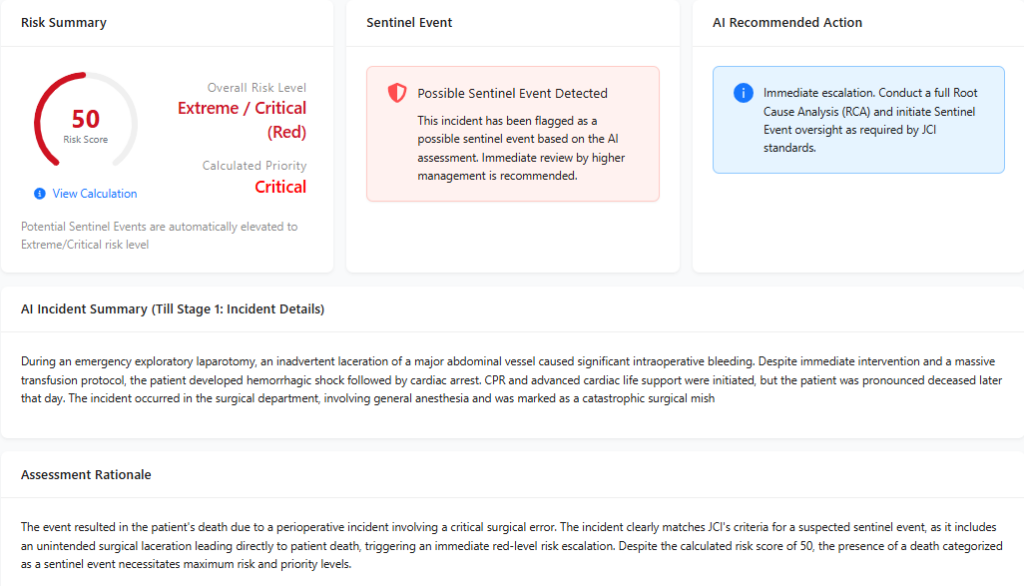
The AI supports reviewers by helping identify potential risks, escalation indicators, reporting obligations, and recurring patterns. It is designed to strengthen review consistency and improve prioritisation – not replace human review or professional decision-making.
Structured RCA and Corrective Action Management
One of the biggest gaps in patient safety is not identifying corrective actions – it is ensuring they are implemented, tracked, measured, and sustained.
QUASR+ supports:
- Root Cause Analysis workflows (with Digital RCA Tools)
- Action assignment and escalation
- Multi-level review and approvals
- Risk triaging and categorisation
- Corrective action tracking
- Trend analysis and reporting
These capabilities help healthcare organisations operationalize stronger interventions rather than defaulting to weaker administrative fixes.
Building a More Mature Safety Culture
Action Hierarchy is not simply a compliance framework. It reflects the maturity of an organisation’s safety culture.
Healthcare organisations that consistently prioritise strong, system-based interventions demonstrate:
- Better organisational learning
- Higher reliability
- Stronger accountability
- Reduced preventable harm
- More proactive governance
The future of patient safety lies not only in reporting incidents, but in building intelligent systems capable of preventing harm before it occurs.
That is the vision QUASR+ supports.
Moving From Reactive to Preventive Safety
One of the most important shifts happening in healthcare today is the move from reactive incident management to predictive and preventive safety systems.
Action Hierarchy plays a central role in that transformation.
The question is no longer: “Did we investigate the incident?”
The real question is: “Did we implement actions strong enough to prevent recurrence?”
That is a much higher standard – and increasingly, the standard expected of modern healthcare organisations.
Final Thoughts
Action Hierarchy matters because it changes the focus from documenting failures to designing safer systems.
The strongest patient safety organisations are not those with the fewest incidents reported. They are the organisations that:
- learn effectively,
- act systematically,
- implement strong corrective actions,
- and continuously improve their systems of care.
At QUASR+, we believe technology should empower that journey. Because better reporting alone does not improve safety. Better action does.