Why AI-Enabled Incident and Learning Systems Are the Future of Healthcare Quality and Patient Safety
Healthcare quality is reaching a turning point. For decades, quality improvement has relied on performance measurement, incident reporting, root cause analysis, corrective action plans and committee review. These practices remain essential, but the environment in which care is delivered has changed dramatically. Patients are more complex, care pathways involve multiple teams and locations, digital systems are deeply embedded in clinical work, and workforce shortages are placing growing pressure on healthcare organisations.
In this environment, patient safety failures rarely arise from a single mistake. They are more often the result of complex interactions between people, processes, technology, and environmental conditions. This means patient safety can no longer be treated only as a clinical issue or a compliance obligation. It has become a systems challenge, and increasingly, a data challenge.
Healthcare organisations now generate more quality and safety information than ever before. Incident reports, near misses, complaints, audits, risk assessments, accreditation findings, electronic health records and operational data all contain signals about where harm may occur. Yet many organisations still struggle to convert this information into timely insight.
The next frontier in healthcare quality is therefore not simply better reporting. It is faster learning, earlier detection and more effective prevention.
Artificial intelligence is beginning to make this shift possible. Used responsibly, AI can help healthcare organisations transform fragmented safety data into actionable intelligence. It can surface patterns, detect early warning signals, prioritise emerging risks and support quality teams in making faster, better-informed decisions. The future of healthcare quality will not be defined by reporting systems alone, but by intelligent learning systems that help organisations prevent harm before it occurs.
Why Traditional Incident Reporting Can No Longer Keep Pace
Incident reporting remains one of the most important tools in patient safety. It helps organisations identify adverse events, near misses, medication errors, falls, equipment failures, communication breakdowns and other safety concerns that may otherwise remain hidden. It also supports investigation, learning, regulatory compliance and accreditation.
However, traditional incident reporting has its limitations. Reporting is selective because not every incident is recognised, reported or escalated. Staff may be too busy, unsure whether an event should be reported, or concerned that reporting may lead to blame. Reporting is also incomplete because incident forms usually capture what the reporter observed, not the full complexity of what happened before, during and after the event. In addition, narrative quality can vary significantly between individuals, making it difficult to compare cases consistently across departments or facilities.
The deeper issue is that incident reporting was never designed to be a proactive risk management system. It was designed to document what happened and support investigation after the event. That remains valuable, but it is no longer sufficient for organisations seeking to move from reactive safety management to proactive prevention.
The key question for healthcare leaders is no longer simply, “How many incidents were reported?” More important questions are emerging: How quickly are risks detected? How rapidly are they escalated? Which actions are reducing recurrence? Where are early warning signals appearing? What could go wrong next?
The Data-Rich, Insight-Poor Challenge
Many healthcare organisations today are data-rich but insight-poor. They collect large volumes of information from incident reporting systems, clinical audits, complaints, risk registers, patient feedback, accreditation findings and operational dashboards. Yet despite this abundance of data, many quality teams remain trapped in manual review cycles.
Valuable safety signals are often buried inside free-text narratives, disconnected systems and historical reports. Quality teams spend significant time categorising incidents, preparing summaries, conducting investigations and generating committee reports. By the time learning is extracted and translated into action, similar incidents may already have occurred elsewhere in the organisation.
This creates what may be called learning latency: the delay between a safety signal appearing and meaningful organisational learning taking place. In many organisations, the pathway from incident to report, investigation, root cause analysis, action plan and review can take weeks or months. During that time, risk may continue to spread, and opportunities for earlier intervention may be missed.
Reducing learning latency should become a leadership priority. The faster an organisation can move from signal to insight, and from insight to action, the greater its ability to prevent repeat harm.
From Explaining Harm to Anticipating Risk
Traditional patient safety processes have focused largely on explaining harm after it occurs. When an adverse event happens, organisations investigate what went wrong, identify contributing factors and implement corrective actions. This is necessary, but it keeps safety management anchored in hindsight.
The future of healthcare quality requires a shift from explaining harm to anticipating risk. This does not mean abandoning incident investigation or root cause analysis. Rather, it means expanding the purpose of incident reporting so that it becomes part of a broader intelligence system. Reports should not only help organisations understand past failures; they should also help identify where future harm may occur.
This requires a different mindset. Instead of viewing incident reporting as the end point of documentation, leaders should see it as the beginning of learning. Every incident narrative, near miss and complaint contains clues about system vulnerabilities. When these signals are analysed across time, departments and facilities, they can reveal patterns that individual case reviews may miss.
This is where incident reporting begins to evolve into risk intelligence. The focus shifts from counting events to understanding risk. It moves from retrospective documentation to proactive prevention, and from isolated case review to enterprise-wide learning.
Learning Systems Are the Next Evolution of Quality Improvement
A learning system continuously converts data into knowledge, applies that knowledge in practice, evaluates outcomes and feeds new learning back into the organisation. In healthcare quality, this means moving beyond the traditional cycle of incident, investigation and closure. The new cycle is signal, learning, knowledge, intervention and prevention.
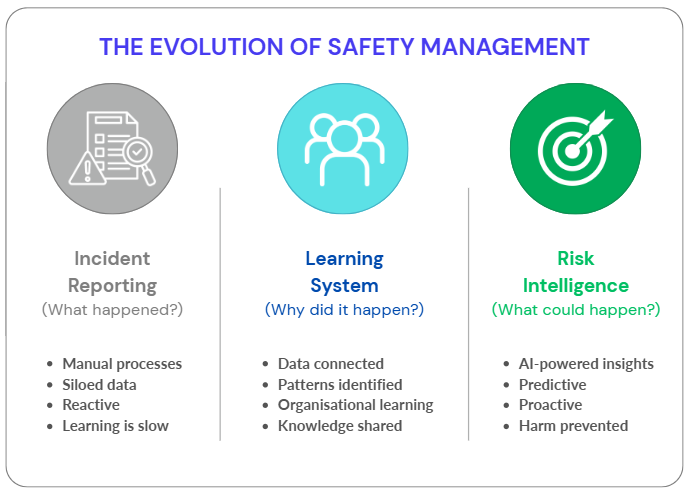
This shift changes the role of technology. Digital systems should not merely store reports or automate workflows. They should help organisations see risk more clearly, connect information across sites, identify trends earlier and evaluate whether interventions are effective. Dashboards should not only display reporting volumes; they should help leaders understand where risk is increasing, which controls are effective and where action is most urgently needed.
The metrics of quality improvement must also evolve. Reporting volume remains useful, but it is not enough. Healthcare organisations should increasingly measure detection speed, learning speed, escalation effectiveness, intervention impact and recurrence reduction. These are the measures that connect quality activity to patient safety outcomes.
Digitalisation was an important first step. Electronic reporting forms, workflow automation and dashboards have improved efficiency and visibility. But digitalisation alone does not create intelligence. Many traditional systems were designed to manage documentation, not to detect weak signals, connect patterns across datasets or predict emerging risk. The next stage of transformation is intelligent learning.
How AI Enables Continuous Risk Intelligence
AI changes the equation because it can analyse large volumes of structured and unstructured data far faster than manual review processes. Its value is not simply automation. Its greater value lies in helping healthcare organisations recognise patterns that would otherwise remain invisible.
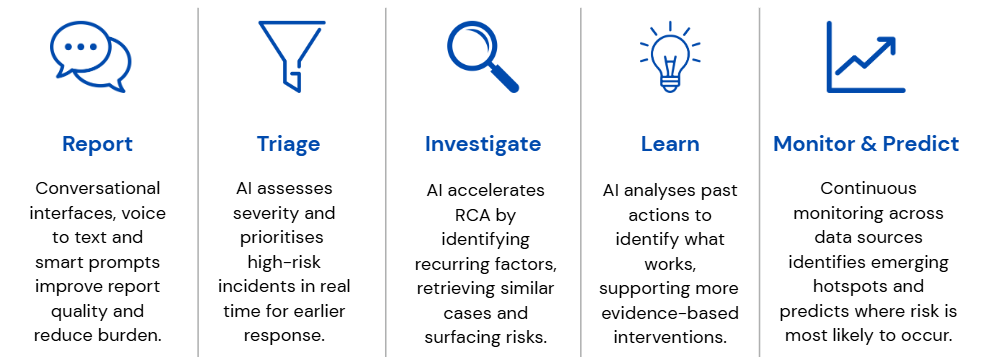
AI can support every stage of the incident lifecycle. During reporting, conversational interfaces, voice-to-text tools and intelligent prompts can reduce documentation burden while improving the completeness and consistency of reports. During triage, AI can help assess severity and prioritise high-risk events in real time, allowing quality teams to respond earlier when prevention is still possible.
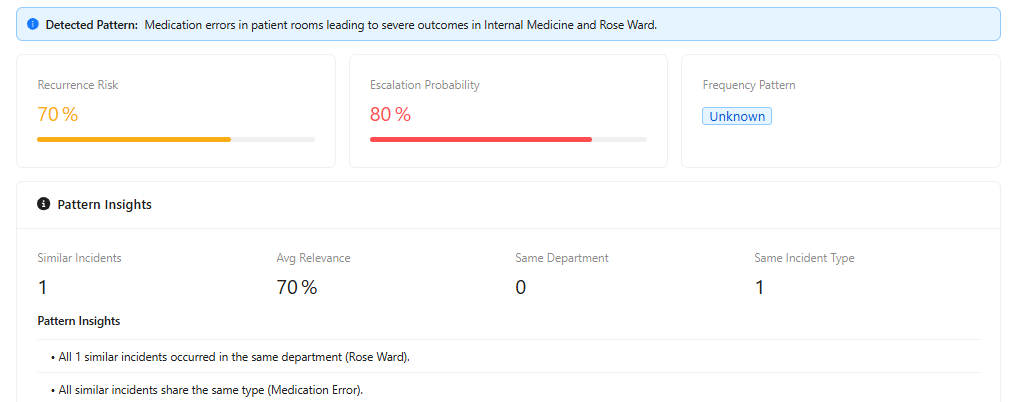
During investigation, AI can assist root cause analysis by identifying recurring contributing factors, constructing timelines, clustering similar incidents and retrieving comparable historical cases through semantic search. This helps organisations move from isolated case review to system-wide learning. Instead of analysing incidents one by one, quality teams can learn across hundreds or thousands of events and identify recurring vulnerabilities.
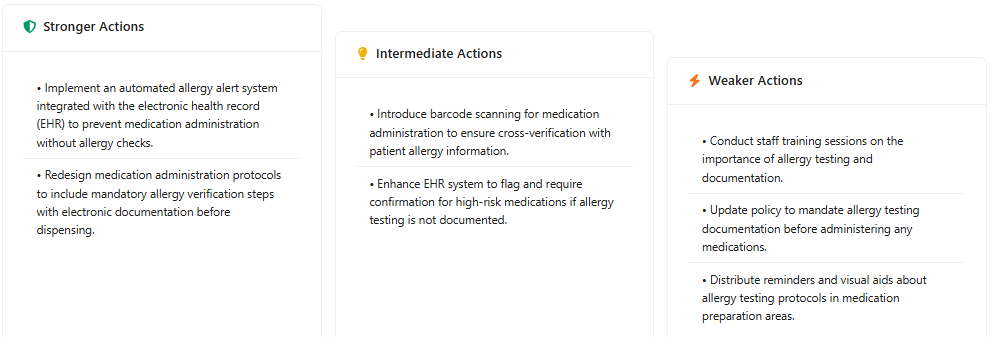
AI can also strengthen action planning. By analysing previous incidents and interventions, it can help identify which corrective actions were most effective in similar situations. Over time, this supports more evidence-based prevention and helps organisations move beyond generic action plans towards targeted, measurable improvements.
The most significant transformation occurs when AI is applied to continuous monitoring. By analysing safety-related information across incident reports, clinical documentation, operational indicators, staffing patterns and other relevant data sources, AI can help detect emerging hotspots and early warning signals. Patient safety then becomes less event-triggered and more signal-driven.
This is the essence of risk intelligence: the ability to detect, interpret and act on signals before harm occurs.
Building Trust Through Responsible AI
AI has enormous potential in healthcare quality and patient safety, but it must be implemented responsibly. Healthcare is a high-consequence environment, and safety decisions require clinical judgement, organisational context and human accountability. AI should assist decision-making, not replace it.
Trust depends on three principles. First, decisions must remain human-led. AI can surface insights, prioritise risks and recommend areas for attention, but healthcare professionals and leaders must remain accountable for decisions and actions. Second, AI should be explainable.
Users need to understand why a risk has been flagged or why a recommendation has been made. Third, governance must be clear, including oversight for validation, privacy, bias, security, performance monitoring and accountability.
The goal is not autonomous safety. The goal is safer decisions at scale. The future of patient safety will depend on effective collaboration between humans, AI and organisational systems. AI can amplify human judgement, but it should not displace it.

The QUASR+ Vision for Intelligent Patient Safety
At QUASR+, we believe incident reporting should no longer be viewed primarily as a compliance function. It should become the foundation of an enterprise-wide risk intelligence capability. The purpose of reporting is not simply to document what happened, but to help organisations learn faster, act earlier and prevent recurrence.
QUASR+ is designed around this shift. By applying AI across the incident lifecycle, QUASR+ helps healthcare organisations move from documentation to prevention, from episodic review to continuous improvement, from hindsight to foresight, and from regulatory compliance to strategic risk intelligence.
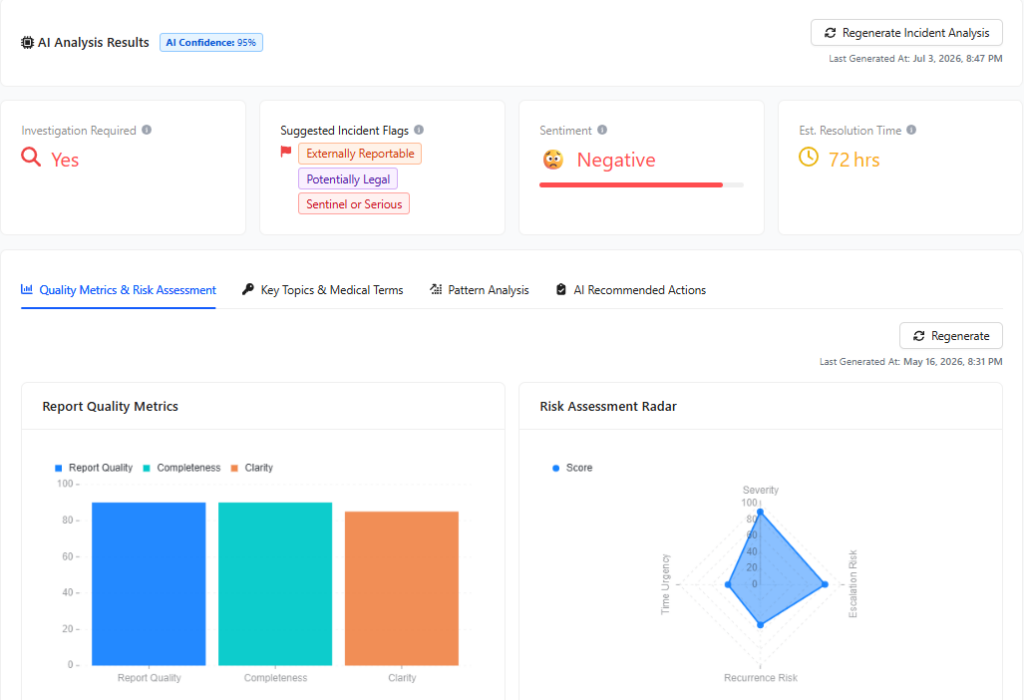
Capabilities such as AI Incident Summarisation, AI-assisted Incident Triage, AI Incident Analysis, AI Semantic Search, and risk intelligence dashboards enable quality teams to work more effectively. These tools reduce administrative burden, improve the consistency of analysis, surface recurring patterns and help leaders identify emerging risks before they become serious events.
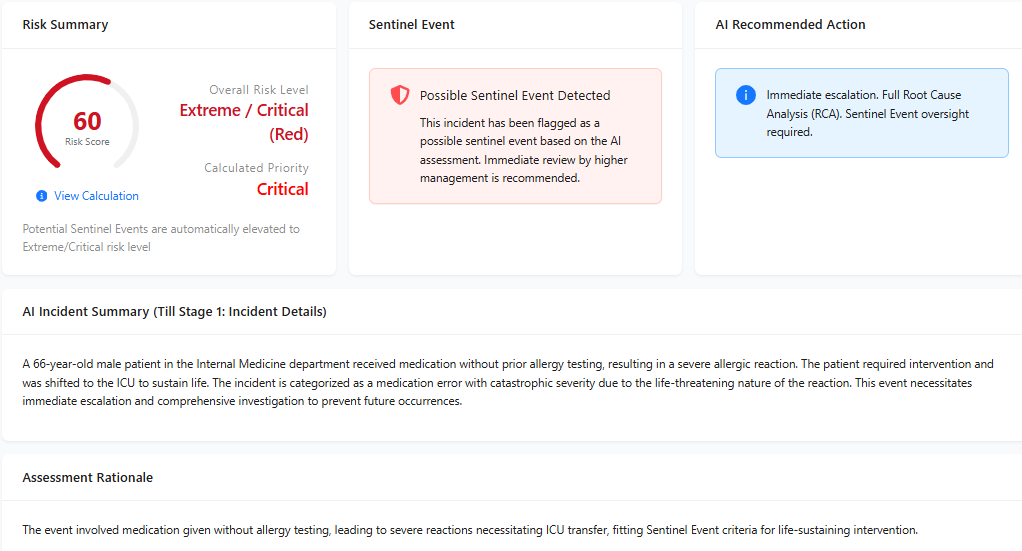
This is not about replacing existing quality processes. It is about strengthening them. AI allows healthcare organisations to close the gap between reporting and learning, and between learning and prevention. In doing so, incident reporting becomes more than a record of past harm. It becomes a proactive safeguard for future safety.
The Future Belongs to Organisations That Learn Faster
Healthcare has reached a strategic inflection point. Most organisations can already report incidents, investigate events and produce action plans. The more important question is whether they can learn quickly enough to prevent the next adverse event from occurring.
The organisations that lead healthcare quality over the next decade will not necessarily be those that collect the most reports. They will be those that detect risk earliest, learn fastest and act most effectively. They will build systems that transform data into insight, insight into action and action into prevention.
AI is making this future increasingly achievable. Combined with strong leadership, responsible governance and a culture of continuous learning, it can transform incident reporting from a retrospective documentation process into an intelligent, proactive safety capability.
The future of healthcare quality will not be measured by how many incidents organisations report. It will be measured by how many incidents never happen because risks were recognised, understood and prevented in time.