The Growing Challenge of Safety Beyond Hospital Walls
Patient safety has traditionally been viewed as a hospital-based concern. Today, however, a growing proportion of healthcare is delivered in ambulatory surgery centres, specialist clinics, imaging facilities, primary care practices, urgent care centres, and multi-site healthcare networks.
While this shift has improved accessibility and convenience for patients, it has also introduced new challenges for healthcare organisations. Care is increasingly delivered across multiple locations, providers, and specialties, making it more difficult to identify, investigate, and learn from patient safety incidents consistently.
The scale of the issue is significant. The World Health Organization estimates that up to four in ten patients experience harm in primary and ambulatory care settings, with as much as 80% of that harm considered preventable. Common adverse events include medication errors, diagnostic delays, healthcare-associated infections, patient falls, and communication failures.
As ambulatory care continues to expand, healthcare organisations need greater visibility across the continuum of care to identify risks earlier and prevent harm more effectively.
Why Ambulatory Care Creates Unique Safety Risks
Unlike hospitals, ambulatory care operates in a highly distributed environment. Patients frequently move between providers, facilities, and care settings while taking greater responsibility for managing medications, monitoring symptoms, and coordinating follow-up care.
As a result, safety risks are often fragmented across multiple systems and locations. A medication-related incident in one clinic may appear unrelated to a similar event reported elsewhere. A diagnostic delay identified in a specialist practice may share common contributing factors with incidents occurring across the broader network.
Viewed individually, these incidents may seem isolated. Viewed collectively, they often reveal systemic vulnerabilities that require organisation-wide attention.
The challenge is that many healthcare organisations lack the tools to connect these signals and identify emerging patterns before they lead to patient harm.
The Limits of Traditional Incident Management
As ambulatory care providers grow through mergers, acquisitions, and regional expansion, managing patient safety becomes increasingly complex.
Many organisations continue to rely on a combination of incident reporting systems, spreadsheets, emails, and manual review processes. Even where dedicated reporting platforms exist, differences in reporting practices, terminology, investigation methods, and safety culture can create inconsistencies across sites.
This fragmentation creates several challenges. Leaders struggle to identify emerging risks across facilities, investigations may produce inconsistent findings for similar events, and lessons learned often remain confined to individual locations rather than being shared across the network.
Most importantly, organisations are often overwhelmed by the volume of data they collect. The challenge is no longer capturing incidents – it is extracting meaningful intelligence from them.
Healthcare leaders increasingly need answers to questions such as:
- Which risks are emerging across multiple facilities?
- Where are similar incidents recurring?
- Are corrective actions reducing risk?
- What harm can be prevented next?
These are intelligence questions, not reporting questions.
Why AI Is Becoming Essential
Healthcare is generating more incident data than quality and risk teams can realistically analyse manually. As a result, AI is becoming an essential tool in modern incident management.
AI excels at identifying patterns within large and complex datasets – an increasingly important capability in multi-site healthcare environments. Rather than replacing risk managers or patient safety professionals, AI augments their capabilities by rapidly analysing incident narratives, categorising events, identifying similarities across facilities, and highlighting emerging risks that require attention.
For example, AI can detect recurring medication-related incidents that are reported differently across multiple clinics but share common underlying factors. It can also uncover trends in diagnostic delays, patient falls, equipment failures, or communication breakdowns that may go unnoticed when incidents are reviewed individually.
Beyond pattern recognition, AI can improve the consistency and quality of investigations. By analysing historical incidents, contributing factors, corrective actions, and outcomes, AI can help investigators identify likely root causes and recommend evidence-based interventions.
Most importantly, AI enables organisations to move from retrospective reporting to predictive risk management. Instead of simply documenting harm after it occurs, healthcare providers can identify early warning signals, anticipate emerging risks, and take proactive action before incidents escalate.
The Future: AI-Powered Risk Intelligence
As ambulatory care networks become larger and more complex, healthcare organisations need more than an electronic incident reporting system. They need a platform that transforms safety data into actionable intelligence.
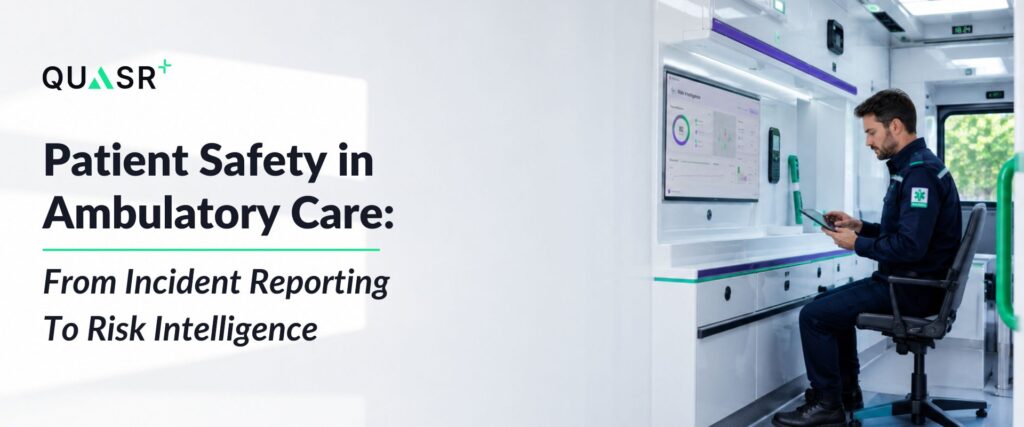
Modern solutions such as QUASR+ represent the next evolution in healthcare incident management. By leveraging AI, these platforms can aggregate information across multiple facilities, support consistent investigations, identify emerging risk patterns, and provide leaders with real-time visibility into enterprise-wide safety performance.
The goal is not simply better reporting. It is earlier detection, faster organisational learning, more effective interventions, and ultimately safer patient care.
Healthcare’s future will be increasingly distributed, data-driven, and interconnected. Organisations that succeed will be those that can transform fragmented incident data into meaningful insights and proactive action. AI will not replace patient safety professionals – it will empower them.
Platforms such as QUASR+ are helping healthcare organisations make the transition from reactive incident management to proactive risk intelligence, enabling them to prevent harm rather than simply respond to it.