The Problem: Too Much Data, Too Little Insights
Healthcare organizations generate large volumes of incident reports every year. These reports capture events such as medication errors, patient falls, equipment failures, near misses, and other safety-related occurrences. While these reports are invaluable for improving patient safety, many healthcare institutions struggle to fully leverage the insights contained within them.
Traditional incident reporting systems rely heavily on structured fields and keyword-based searches. However, incident descriptions are often written in free text, where clinicians describe events in their own words. This creates several challenges:
- Inconsistent terminology: Different clinicians may describe the same event differently.
- Difficulty retrieving similar cases: Keyword searches often miss relevant reports if the exact terms are not used.
- Time-consuming investigations: Risk managers and safety teams must manually sift through reports to identify similar incidents.
- Missed learning opportunities: Valuable insights from past incidents may remain hidden within large databases of reports.
As a result, healthcare organizations often fail to identify patterns or learn from previous incidents quickly enough, limiting their ability to prevent future harm.
This is where AI semantic search offers a transformative solution.
How AI Semantic Search Addresses These Challenges
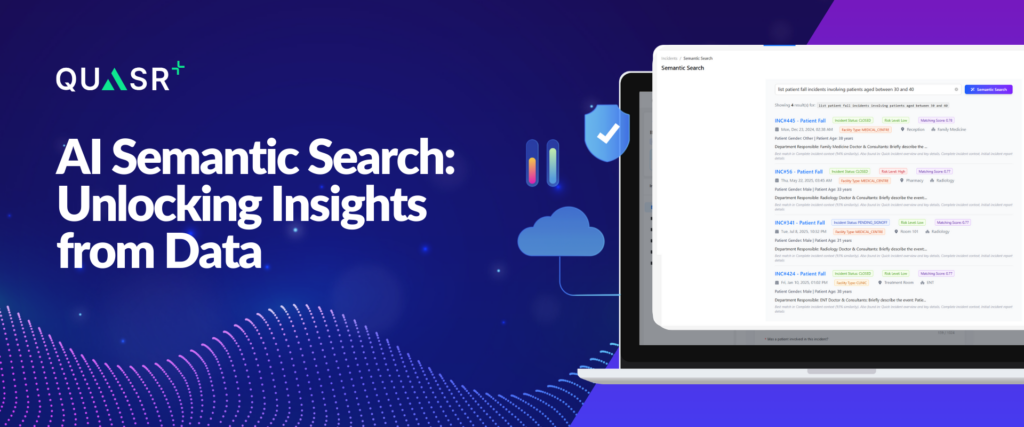
AI semantic search enables healthcare systems to search incident reports based on meaning and context, rather than relying solely on exact keyword matches. Using technologies such as natural language processing (NLP) and vector embeddings, AI semantic search converts incident narratives into mathematical representations that capture their semantic meaning. Instead of searching for specific words, semantic search interprets concepts, relationships, and contextual similarities across documents.
For example, the system can recognize that the following descriptions may refer to similar clinical events:
- “Patient became dizzy and collapsed”
- “Resident experienced a syncopal episode”
- “Individual fainted while ambulating”
Although the language differs, semantic search understands that these narratives describe related safety events.
By identifying conceptual similarities, semantic search enables healthcare organizations to analyze large volumes of narrative data and uncover patterns that traditional search methods would miss. This can lead to:
- Faster investigations
- Improved root cause analysis
- More effective patient safety interventions
- Better knowledge sharing across departments
Key Use Cases of AI Semantic Search in Incident Reporting
-
Finding Similar Incidents During Investigations
When a serious incident occurs, investigators need to determine whether similar events have happened before. AI semantic search allows safety teams to input a description of the incident and instantly retrieve historically similar reports across the organization.
For example, if a medication overdose occurs, investigators can quickly find previous overdose cases involving:
- Similar drugs
- Similar patient demographics
- Similar workflow breakdowns
This helps investigators identify recurring system issues and avoid repeating past mistakes.
-
Supporting Root Cause Analysis
Root cause analysis (RCA) requires investigators to understand how and why incidents occur. Semantic search can surface reports with similar contributing factors, even if they are described differently.
For example, an investigator examining a patient fall may retrieve reports mentioning:
- “patient slipped when getting out of bed”
- “fall during transfer from wheelchair”
- “unassisted ambulation leading to fall”
Although the wording differs, semantic search identifies the common underlying safety risk. This provides valuable context that strengthens RCA findings and corrective actions.
-
Identifying Emerging Safety Risks
Healthcare organizations must detect emerging safety risks early. By enabling users to explore clusters of similar incidents, semantic search helps safety teams uncover patterns that might otherwise remain hidden.
For example, semantic search might reveal multiple incidents describing:
- infusion pump alarms not being heard
- delayed response to pump alerts
- pump malfunction during medication delivery
These reports may indicate a systemic equipment or workflow issue that requires intervention.
-
Improving Staff Learning and Training
Incident reporting systems contain a wealth of real-world clinical learning scenarios.
Semantic search allows educators and safety leaders to retrieve incident reports related to specific topics, such as:
- medication administration errors
- surgical instrument miscounts
- infection control breaches
These reports can be used to develop training materials, simulation exercises, and case-based learning sessions, helping staff learn directly from real incidents.
-
Enhancing Organizational Knowledge Sharing
Large healthcare organizations often operate across multiple hospitals or departments. Valuable safety lessons from one department may not easily reach another. AI semantic search enables clinicians and safety teams to discover relevant incidents across different units, specialties, or facilities.
For example, a paediatrics unit investigating a medication error may retrieve similar cases from adult wards that provide useful insights into workflow vulnerabilities or documentation issues.
This promotes cross-departmental learning and system-wide safety improvements.
Key Considerations for Implementing AI Semantic Search
While AI semantic search offers significant benefits, successful implementation requires thoughtful planning.
-
Data Quality and Governance
AI systems depend heavily on the quality and accessibility of underlying data. Organizations must ensure that incident data is captured consistently and integrated across systems.
Clear data governance frameworks should define data ownership, standardize definitions, and establish processes for maintaining data accuracy. Without strong data foundations, AI analytics will produce limited value.
-
Privacy and Patient Confidentiality
Healthcare incident reports often contain sensitive patient information. Organizations must ensure that AI systems comply with privacy regulations and data governance policies.
Security measures should include encrypted data storage, de-identification, secure processing environments, role-based access controls, and detailed audit logs.
-
Clinical Context and Domain Expertise
Healthcare is a specialized domain with complex terminology and workflows. Generic AI models may struggle to interpret clinical narratives accurately.
Effective semantic search solutions must incorporate healthcare-specific language models and involve domain experts during model development and validation. Clinical input ensures that the insights generated by the system are meaningful and reliable.
-
Transparency and Explainability
For AI tools to be trusted by safety and quality leaders, they must provide transparent and explainable outputs.
Users should be able to understand why incidents were grouped together or flagged as potential risks. Explainable AI helps prevent “black box” decision-making and encourages broader adoption of the technology.
-
Change Management and Adoption
Technology alone does not transform safety culture. Successful implementation requires leadership sponsorship, staff training, and integration into existing safety workflows.
AI tools should augment human expertise rather than replace it, helping safety teams work more efficiently while preserving professional judgment.
AI Semantic Search vs AI Analytics
Although both technologies use artificial intelligence, they serve different purposes within incident reporting systems. In practice, these technologies complement each other.
Semantic search helps users find relevant incidents, while AI analytics helps organizations understand trends and systemic risks across all incidents. Together, they provide a more comprehensive approach to patient safety intelligence.
| Feature | AI Semantic Search | AI Analytics |
|---|---|---|
| Primary Goal | Retrieve relevant incident reports | Analyze incident data to generate insights |
| Data Type | Primarily narrative text | Structured datasets and metrics |
| Output | Similar incidents or relevant reports | Trends, patterns, and predictive insights |
| Example Question | “Show me similar medication errors.” | “Why have medication errors increased this quarter?” |
| Use Case | Investigation support and knowledge retrieval | Safety monitoring and performance analysis |
Conclusion
Healthcare incident reporting systems contain vast amounts of valuable safety data, yet much of this information remains difficult to access using traditional search tools.
AI semantic search transforms how healthcare organizations interact with incident data by enabling users to retrieve reports based on meaning rather than keywords. This capability allows safety teams to quickly find similar incidents, strengthen investigations, detect emerging risks, and promote knowledge sharing across departments.
When implemented thoughtfully, with careful attention to data quality, privacy, transparency, and user adoption, AI semantic search can significantly enhance the effectiveness of incident reporting systems.
Combined with AI analytics, it forms a powerful foundation for data-driven patient safety improvement, helping healthcare organizations move from simply reporting incidents to actively learning from them and preventing future harm.