From Reporting to Prevention: Turning Safety Data into Strategic Intelligence
Introduction
Healthcare service providers face a common and persistent dilemma: incident reporting systems generate vast volumes of data – rich with narrative detail – but traditional analytic methods struggle to turn that data into meaningful, actionable insights. This bottleneck undermines timely safety learning, limits organizational-wide risk detection, and hampers proactive prevention strategies.
Advances AI – particularly natural language processing (NLP), large language models (LLMs), and machine learning (ML) – are changing this dynamic. When embedded directly into incident reporting systems, AI transforms narrative-heavy safety data into structured, scalable intelligence. Reporting evolves from documentation into a proactive engine for risk detection and harm prevention.
The Reporting Paradox: Too Much Data, Too Little Insight
Incident reporting is foundational to patient safety – frontline staff submit reports so organizations can learn and prevent recurrence. However, four persistent challenges limit its impact.
- Overwhelming volume of unstructured data
Most incident reports are narrative-based. These free-text descriptions contain valuable contextual insights, but manual review does not scale effectively across large datasets.As a result:
- Low-harm and near miss events are often under-analyzed
- Latent system risks remain buried in narrative text
- Learning is limited to a small subset of serious harm event.
This creates significant blind spots in organizational risk visibility.
- Inconsistent categorization
Manual coding introduces variability across departments, reviewers, and sites. Inconsistent categorization weakens:- Trend reliability
- Cross-site benchmarking
- Confidence in board-level reporting
Without standardization, safety insights lack comparability and strategic credibility.
- Delayed detection of emerging risks
Traditional dashboards rely on frequency counts and predefined categories. While useful for monitoring known risks, they struggle to detect:- Subtle shifts in patterns
- Emerging clusters
- Cross-departmental signals
- Weak signals hidden in low-harm reports
Evidence shows that early signals often appear in near-miss data before escalating into serious harm. Without scalable analytics, those signals remain unnoticed.
- Resource-intensive root cause analysis
RCA remains essential but is typically reserved for severe harm events due to the time and personnel required.As a result:
- Contributing factors in moderate and low-harm events go unexplored
- Organizational learning remains episodic
- Prevention opportunities are delayed
Collectively, these barriers turn incident reporting into a data repository rather than active engines of safety intelligence and harm prevention.
Why AI Analytics Is the Next Frontier
AI technologies are uniquely suited to incident reporting because they excel at extracting structured meaning from unstructured text.
Peer-reviewed research demonstrates that NLP and machine learning can:
- Accurately classify patient safety incidents
- Identify contributing factors from free text
- Detect safety signals earlier than traditional review methods
When embedded directly into incident reporting platforms, AI enables a shift from:
- Manual triage → Intelligent prioritization
- Static dashboards → Pattern detection
- Selective RCA → Scalable causal insight
- Retrospective reporting → Predictive risk intelligence
For quality, safety, and risk leaders, this means faster insights, greater consistency, and stronger strategic oversight.
Five High-Impact AI Use Cases
- Automated Classification and Severity Scoring
AI models can instantly structure text-heavy narrative incident reports into standardized categories and estimate likely harm severity. This reduces subjectivity, improves consistency, and accelerates prioritization for review and escalation. (Read the blog article on AI Incident Triage).
- AI Summarization – Turning Narratives into Clear, Actionable Briefs
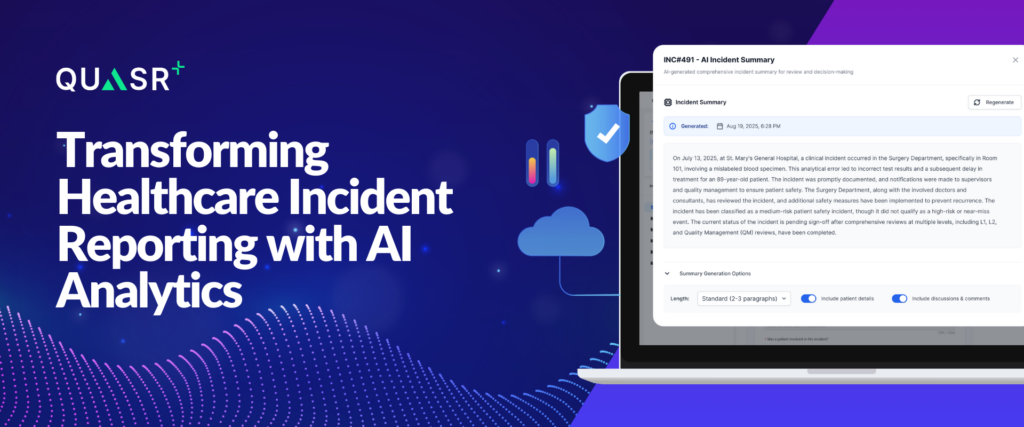
LLMs can generate concise summaries of lengthy reports, highlight the key elements of each event and surface critical details. These summaries help safety committees, clinical reviewers, and leadership quickly understand events without having to comb through pages of text.For safety committee and executives, this reduces review time while improving clarity and consistency. (Read the blog article on AI Incident Summarization).
- AI-Assisted RCA and Contributing Factor Extraction
AI tools can extract probable contributing factors from narrative text and identify recurring causal themes across large datasets.Rather than limiting RCA to a small number of severe cases, organizations can analyze patterns across hundreds of events, expanding learning beyond isolated investigations.Importantly, AI augments, not replaces, human expertise.
- Trend and Anomaly Detection
AI-driven trend analysis goes beyond simple frequency counts. Advanced models can detect unusual clusters, anomalies, early-stage risk patterns, and corelations cross departments.In safety-critical industries, anomaly detection has proven essential for early risk identification. Healthcare is now applying similar methodologies to safety reporting.For quality leaders, this capability enables earlier interventions before trends mature into serious harm events.
- Predictive Analytics – From Reactive to Proactive Safety
Perhaps the most transformative capability is predictive analytics – using historical report patterns and contextual data to anticipate where and when similar safety events might re-occur.Predictive models in healthcare more broadly have shown value in foreseeing clinical deterioration and operational bottlenecks, enabling targeted pre-emptive action.Applied to safety reporting, predictive analytics helps organizations shift from reacting to past events toward preventing future harm.
This allows safety leaders to deploy targeted interventions before harm escalates and prioritize safety improvements.
Strategic Benefits for Quality, Safety and Risk Leaders
AI-powered incident reporting systems deliver measurable advantages across operational and executive levels:
- Faster, More Accurate Insights – Automating analysis and summarisation reduces manual workload and accelerates insights, freeing teams to focus on learning and action, not data preparation.
- Consistent, Scalable Learning – AI delivers consistent categorisation and signal detection across large data sets, reducing variability in how reports are interpreted and coded over time and across departments.
- Early Warning & Prevention – By detecting subtle trends and predicting potential risk areas, AI enables clinical risk managers to intervene earlier before harm escalates into serious patient safety events.
- Stronger Feedback Loops – When insights are generated quickly and clearly, organisations can close the loop with frontline staff – reinforcing psychological safety and reporting engagement. High-reliability organizations depend on rapid learning cycles. AI strengthens those cycles.
Conclusion: From Documentation to Prevention
Incident reporting has long been central to quality and safety programs. Yet its true value is realized only when organizations can learn from data at scale and act before harm escalates.
AI analytics unlocks that potential. By structuring narrative data, identifying contributing factors, detecting emerging patterns, and forecasting future risks, AI transforms reporting into a strategic capability.
In today’s complex healthcare environment – characterised by workforce pressures, operational strain, and increasing care complexity – reactive systems are no longer sufficient. Safety leaders require tools that match the scale and speed of modern risk.
AI enables quality, safety, and risk teams to do what matters most: Prevent harm before it occurs – not just documenting it after the fact.