Reduce Case Review Time by Over 80%
Problem Statement
In healthcare environments, incident reporting is critical for ensuring patient safety and continuous quality improvement. However, the growing volume and complexity of incident data have created a significant operational challenge.
Quality teams are required to review hundreds of incident reports that often contain:
- Lengthy, unstructured narratives
- Investigation notes, root cause analyses (RCA), and recommendations
- Fragmented inputs across multiple workflows and stakeholders
This makes the review process highly manual, time-consuming, and inconsistent. Research shows that incident data is often ambiguous and inconsistently structured, making it difficult to extract actionable insights efficiently. At the same time, increasing volumes of reports and alerts can overwhelm human reviewers, delaying decision-making and response.
In practice, quality managers may spend 20–40 minutes reviewing a single incident, translating to several hours just to review a handful of cases. This is not only resource-intensive but also limits the organisation’s ability to respond, learn, and improve at scale. It creates a bottleneck between incident reporting and meaningful improvement and prevention.
How QUASR+ AI Incident Summarisation Works
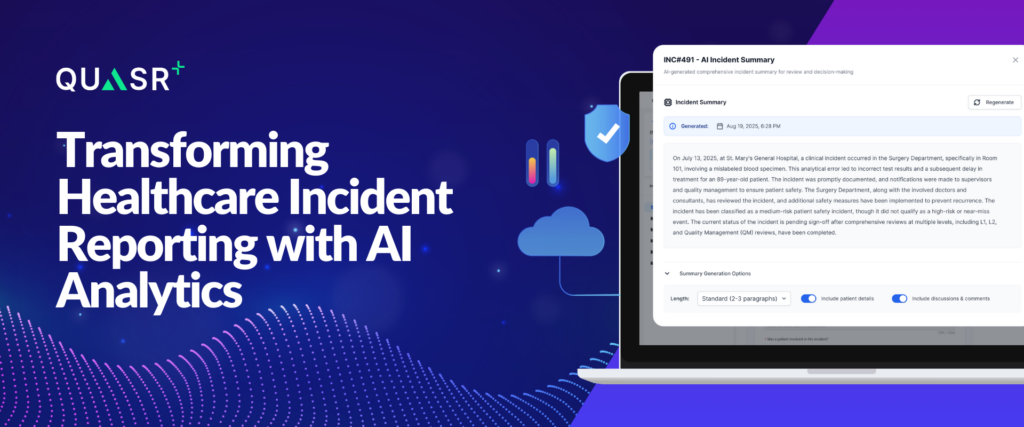
QUASR+ AI Incident Summarisation leverages advanced natural language processing (NLP) and large language models (LLMs) to automatically convert complex incident records into structured, concise summaries.
The feature:
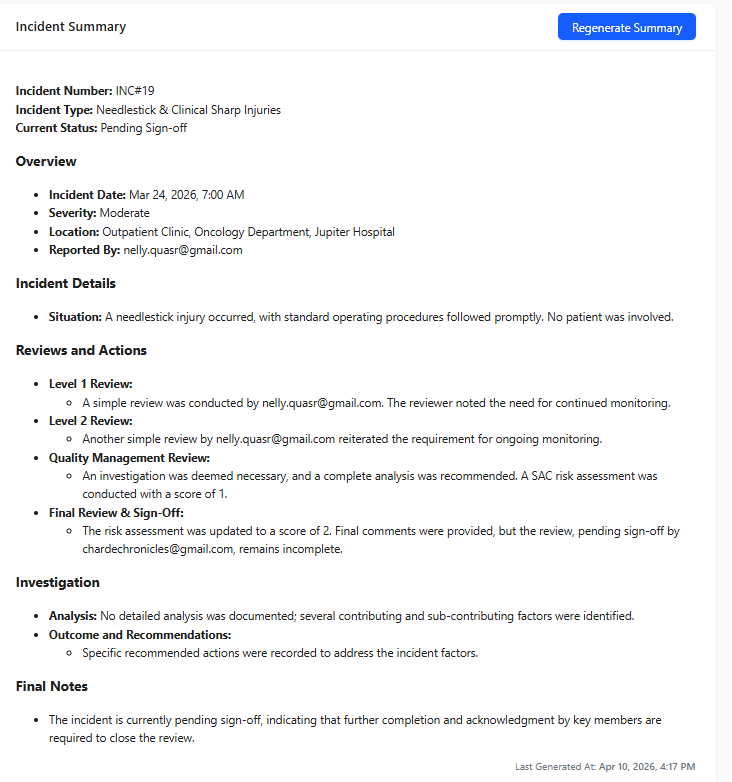
- Analyses full incident lifecycle data including descriptions, logs, comments, and RCA outputs
- Extracts key elements, such as:
- Incident overview
- Quality and risk assessment
- Investigation findings and root causes
- Recommended actions
- Generates a clear, structured, and concise summary for immediate review
The system is:
- Natively embedded within QUASR+ workflows
- Context-aware, using complete incident data across its lifecycle
- Aligned with patient safety and quality frameworks
- Dynamic, allowing users to regenerate summaries as new information is added
This feature transforms fragmented and unstructured incident data into decision-ready insights within seconds.
How QUASR+ Solves the Problem
By automating the interpretation and summarisation of incident reports, QUASR+ AI Incident Summarisation feature removes the need for manual reconstruction of events.
Instead of spending time:
- Reading through lengthy reports
- Piecing together timelines
- Interpreting root causes
Quality teams receive instant, concise, and structured summaries that highlight all the key information on the incident.
This approach aligns with emerging research showing that AI-driven summarisation systems can synthesize large volumes of operational data into coherent narratives, enabling faster diagnosis and response. AI-enabled incident management has also been shown to significantly improve response times and decision quality.
As a result, QUASR+ AI Incident Summarisation feature:
- Eliminates review bottlenecks
- Standardizes interpretation across teams
- Accelerates the transition from reporting to action
Sample AI-Generated Incident Summary Report
Key Benefits and Value
1. Accelerated Incident Review
- Reduces Review Time by over 80% (from 20–40 minutes to 3–5 minutes per case)
- Enables faster case closure and escalation
- Increases overall team productivity and throughput
2. Improved Data Quality & Consistency
- Converts unstructured inputs into standardized outputs
- Reduces variability in interpretation across reviewers
- Enhances auditability and reporting quality
3. Enhanced Learning & Insight Generation
- Makes it easier to:
- Identify recurring patterns and systemic risks
- Extract and share lessons learned
- Supports cross-department and cross-facility learning
- Transforms incidents into reusable organisational knowledge
4. Better Decision-Making
- Highlights critical insights for:
- Risk prioritization
- Leadership reporting
- Safety interventions
- Enables faster, more informed actions in high-stakes environments
Summary & Strategic Impact
QUASR+ transforms incident review from a manual, time-intensive process into an intelligent and efficiency process. By turning complex and often ambiguous incident data into clear, structured, and actionable insights, healthcare organisations can:
- Shorten incident review cycles significantly
- Act faster to mitigate harm
- Improve reporting accuracy
- Strengthen a culture of continuous learning and safety
- Drive measurable improvements in patient outcomes
In increasingly complex healthcare systems, the ability to rapidly interpret and respond to incident data is a critical differentiator. QUASR+ enables organisations to move beyond reactive incident handling toward proactive, insight-driven quality management at scale.
QUASR+ AI Incident Summarisation ensures that every incident becomes a clear, actionable insight – empowering teams to review faster, learn continuously, and improve patient safety outcomes
Related Blog: AI Incident Summarisation: Accelerating Review and Learning