Faster triage. Safer, more consistent outcomes.
Problem Statement
Healthcare organisations generate large volumes of incident reports, many containing rich but unstructured narratives. As reporting increases, quality and risk teams face growing challenges in reviewing and triaging incidents in a timely, consistent, and scalable manner.
This often leads to:
- Significant time spent on manual review instead of proactive risk management
- Variability in prioritisation across reviewers
- Risk of delayed identification of high-severity incidents
- Limited ability to detect emerging patterns across datasets
The challenge is no longer data collection, but the ability to safely and consistently prioritise incidents while maintaining appropriate clinical and governance oversight.
The Solution: QUASR+ AI-Assisted Incident Triage
QUASR+ AI-Assisted Incident Triage is a decision-support tool designed to support healthcare quality and risk teams in the initial prioritisation of incident reports.
It enhances, but does not replace, professional judgement by:
- Structuring unstructured incident data
- Highlighting potential risk signals
- Supporting consistent prioritisation aligned to organisational frameworks
- Enabling earlier identification of high-risk and system-level issues
All outputs are designed to support human review and governance processes, with final decisions remaining the responsibility of the quality team.
How It Works
QUASR+ functions as an AI-enabled triage support assistant, analysing incident reports at scale and presenting structured insights to assist reviewers.
a. Narrative Understanding
- Analyses free-text incident reports using natural language processing
- Extracts key elements such as event type, contributing factors, and indicators of harm
- Converts unstructured narratives into structured summaries and data fields
- Generates concise summaries to support rapid review
b. Risk Signal Identification and Prioritisation Support
- Applies configurable risk models aligned to organisation-specific risk matrices (e.g., severity and likelihood frameworks)
- Highlights incidents that may require urgent attention based on defined criteria
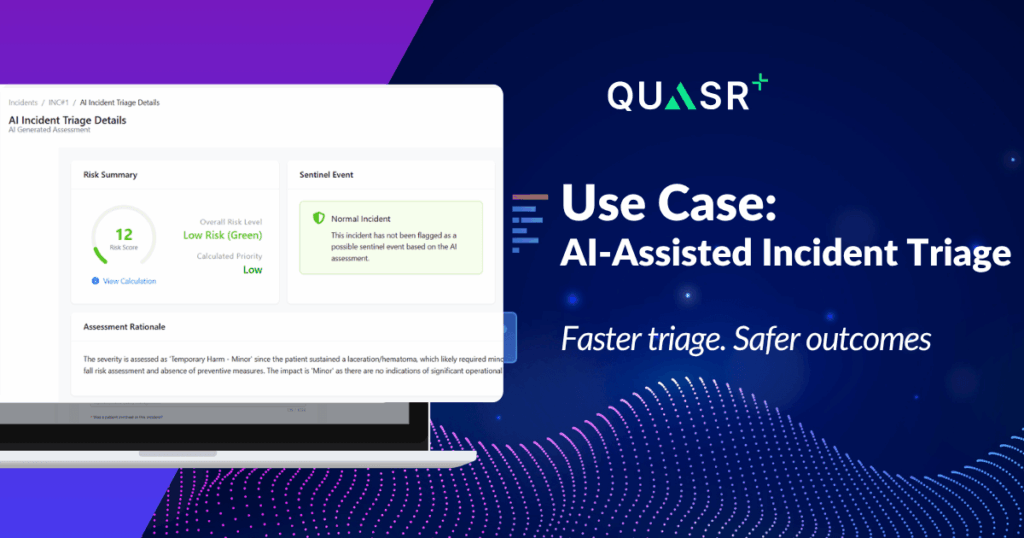
- Flags potential high-risk or sentinel event indicators for immediate human review
- Supports consistent prioritisation across teams while maintaining transparency of underlying factors
The system has built-in capability to flag potential sentinel events (based on JCI definitions) and assign Extreme/Critical Risk to these incidents for immediate human review.
Additionally, QUASR+ identifies similar incidents across departments and facilities, enabling early detection of emerging risks before they escalate.
Together, these capabilities transform incident data into a real-time prioritisation and early warning system.
Note: QUASR+ AI-Assisted Incident Triage Risk Scoring is based on initial incident reports and does not incorporate subsequent inputs from the quality and investigation teams.
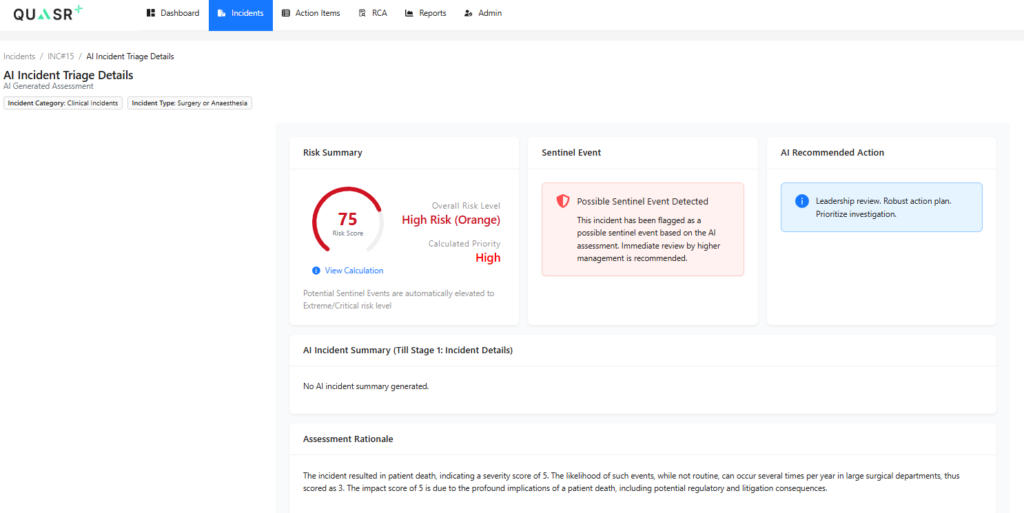
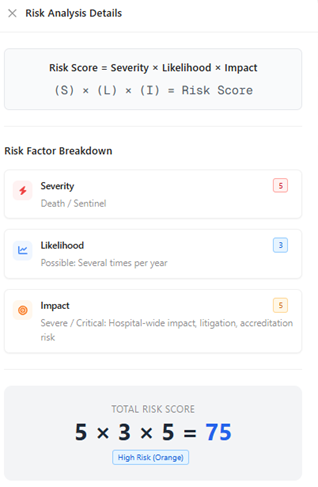
Fig. Sample Screenshot: QUASR+ AI-Assisted Incident Triage
Clinical Safety and Governance Safeguards
QUASR+ is designed in accordance with international AI governance principles and incorporates the following safeguards:
- Human-in-the-loop oversight: All outputs are subject to review and validation by qualified personnel.
- Transparency and explainability: Key factors influencing outputs are visible to users to support informed decision-making.
- Bias and limitation awareness: Outputs are dependent on input data quality and should be interpreted within clinical and operational context
- Auditability: Outputs and interactions can be logged to support governance, review, and continuous improvement
The system supports initial triage based on reported incident details. It does not replace formal investigation, clinical assessment, or regulatory reporting processes.
QUASR+ is also designed to align with international data protection and healthcare policy frameworks, which require secure handling of sensitive health information and role-based access controls and audit trails, among others.
Key Benefits
Operational Efficiency
- Reduces manual triage workload
- Supports faster identification of potentially critical incidents
- Improves workflow efficiency across quality and risk teams
Consistency and Transparency
- Promotes standardised prioritisation aligned to organisational frameworks
- Reduces variability across reviewers
- Enhances traceability of triage decisions
Enhanced Safety Intelligence
- Enables earlier identification of emerging risks
- Supports analysis of trends across large datasets
- Strengthens evidence-based safety and quality improvement
Workforce Enablement
- Allows clinical and quality teams to focus on higher-value activities
- Supports decision-making without replacing professional expertise
Strategic Impact
QUASR+ supports a transition from reactive incident handling to proactive, insight-driven safety management by:
- Transforming incident data into actionable intelligence
- Enabling earlier intervention and risk mitigation
- Supporting continuous learning across the organisation
- Strengthening clinical governance and compliance frameworks
By augmenting human expertise with AI-assisted insights, QUASR+ helps healthcare organisations improve safety outcomes while maintaining trust, accountability, and regulatory alignment.