Search smarter. Stop repeat harm
Problem Statement
Healthcare quality teams collect large volumes of incident data, much of which is stored as unstructured narrative text. In most systems, retrieving relevant past incidents relies heavily on exact keyword searches, manual review, and individual familiarity with how reports were written.
This creates significant challenges when identifying similar incidents described using different terms. For example, fall-related events may be documented as “collapsed,” “lost balance,” or “syncopal episode,” making them difficult to retrieve through keyword search alone. Similarly, device-related issues may remain undetected due to inconsistent reporting across departments and locations.
As a result, quality teams spend considerable time reviewing reports manually, yet still risk missing critical patterns. The core challenge is not just collecting incident data but how to turn narrative incident data into actionable insights to prevent repeat harm.
Solution: QUASR+ AI Semantic Search
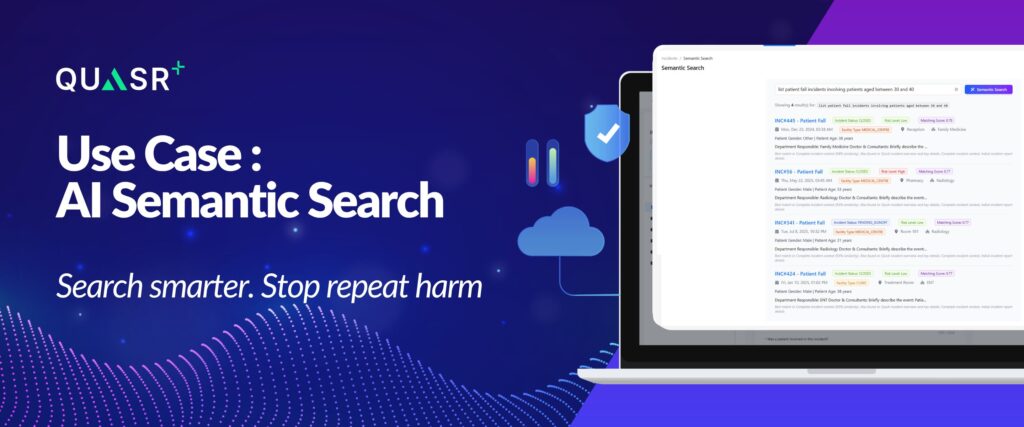
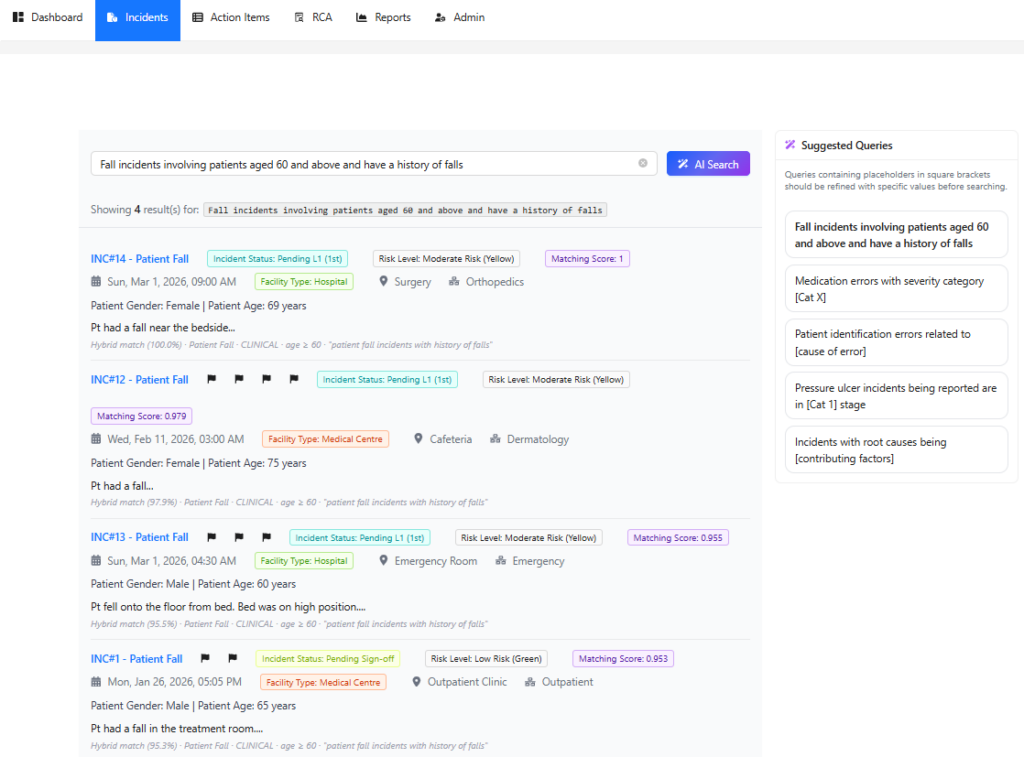
QUASR+ addresses this challenge using semantic search, which retrieves incidents based on meaning and context rather than exact keyword matches.
The system converts user queries into numerical representations of meaning (embeddings) and identifies incidents with similar contextual relevance. This enables recognition of conceptually similar phrases, for example, linking “handover failure” with “communication breakdown.”
To enhance search accuracy, QUASR+ employs a hybrid search approach that combines:
- Semantic search (context and meaning)
- Full-text search (exact keyword matching)
- Structured filters (based on predefined taxonomy)
How It Works
QUASR+ processes incident data in two complementary forms:
a. Unstructured Narrative Data Includes incident descriptions, actions taken, investigation findings, and stakeholder comments. Semantic search is applied to extract meaning from this free-text content.
b. Structured Data Includes standardized fields such as Incident Type, Contributing Factors, Sub-contributing Factors, Outcome Categories, and Outcome Recommendations. These are selected from organization-specific taxonomies.
The system translates a user’s natural language query into:
- A semantic query component
- Relevant structured filters aligned with the organization’s taxonomy
Search is executed using both vector-based (semantic) and keyword-based methods in parallel. Results are then combined using Reciprocal Rank Fusion (RRF)*, ensuring both conceptual matches and exact terms (e.g., drug names) are captured.
*RRF is a method for combining multiple ranked search result lists into a single, optimized ranking without requiring score normalization. It excels at hybrid search.
Key Benefits
- Faster investigations – Quickly identify similar past incidents
- Improved insight extraction – Unlock value from unstructured narrative data
- Enhanced patient safety – Detect and address recurring risks earlier
- Stronger organizational learning – Share insights across teams and sites
- Scalable analysis – Efficiently process large volumes of incident data
AI search does not directly reduce harm. It enables better decisions. Its value shows up across efficiency, quality, and outcomes. The biggest gains usually come from:
- Better recall of relevant incidents
- Reduced human search effort
- More consistent investigations
Strategic Impact
QUASR+ AI Semantic Search transforms incident management from a reactive process into a proactive safety intelligence capability. Its supports the broader industry need to move from gathering incident data to learning from it at scale. By enabling faster and more accurate retrieval of relevant incidents, healthcare organizations can learn more effectively from past events, reduce repeat harm, and make better-informed decisions.