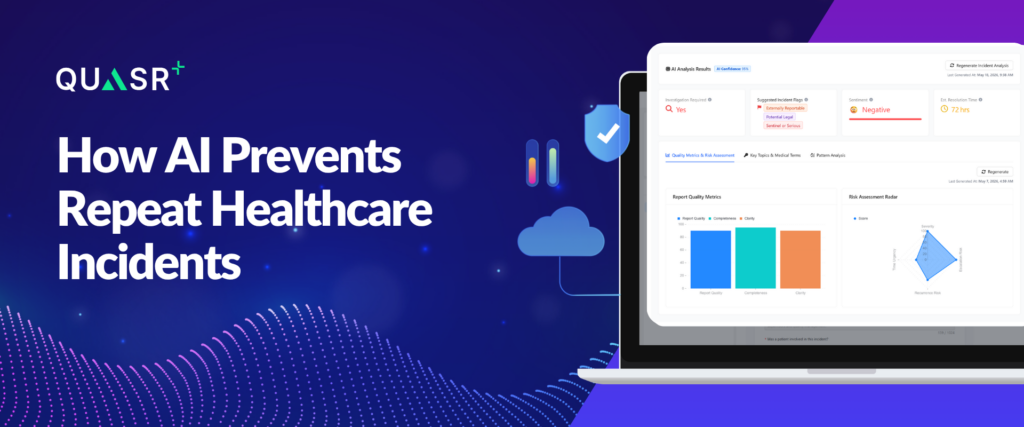
Turning safety data into actionable risk intelligence.
Healthcare organisations have invested heavily in incident reporting systems, patient safety programmes, and quality improvement initiatives. Yet repeat safety incidents continue to occur across healthcare settings.
Medication errors recur. Patient falls continue to happen. Communication breakdowns during handovers lead to repeated near misses. Workplace injuries affect healthcare workers. Patient complaints often reveal recurring service gaps that remain unresolved.
The challenge is not a lack of reporting. Most healthcare organisations collect large volumes of incident reports, near misses, complaints, and safety observations. The challenge is turning that information into actionable insights quickly enough to prevent similar incidents from happening again.
This is where artificial intelligence (AI) is beginning to transform patient safety.
By helping healthcare organisations identify patterns, detect emerging risks, and accelerate learning from incidents, AI enables hospitals to move beyond documenting incidents and toward preventing them.
Why Repeat Incidents Continue to Occur
Traditional incident reporting systems capture events after they occur. Quality and safety teams then review and investigate the reports, assign corrective actions, share lessons learned, and close the case.
While this process remains essential, it is often slow and heavily dependent on manual analysis.
Healthcare organisations commonly face:
- Large volumes of reports that are difficult to review manually.
- Inconsistent categorization and reporting practices.
- Delays between reporting, investigation, and action.
- Limited visibility across departments or facilities.
- Difficulty identifying trends before serious harm occurs.
Effective incident reporting and learning systems are critical to improving patient safety and preventing harm, but extracting meaningful learning from large volumes of reports remains a major challenge.
As healthcare systems grow more complex, many safety teams struggle to spot patterns buried in thousands of reports. By the time a trend is recognised, the same incident may already have happened again.
How AI Helps Prevent Repeat Safety Incidents
AI does not replace healthcare professionals or safety teams. Instead, it helps them process information faster, uncover hidden patterns, and focus attention on the risks that matter most.
1. Identifying Patterns Humans May Miss
One of AI’s greatest strengths is its ability to analyse thousands of reports simultaneously.
Traditional reviews often focus on individual incidents. AI can identify recurring themes, contributing factors, and relationships across large datasets that would be difficult to detect manually.
For example, AI may discover that:
- Patient falls increase during shift changes.
- Medication administration errors occur more frequently in a particular unit.
- Similar near misses are appearing across multiple facilities.
- Workplace incidents spike during periods of staffing shortages.
These insights allow safety teams to address systemic issues before they result in serious harm.
2. Detecting Early Warning Signals
Serious adverse events are often preceded by minor incidents and near misses.
AI can continuously analyse incident reports and narratives to identify clusters of low-level events that may signal growing risk.
For example, a hospital may receive several reports involving delayed medication delivery. Individually, each report appears minor. However, AI may identify a broader pattern linked to workflow bottlenecks, staffing pressures, or communication failures.
Instead of waiting for a serious medication event, leaders can intervene early.
3. Accelerating Root Cause Analysis
Root cause analysis (RCA) is one of the most valuable patient safety activities, but it is also resource intensive.
AI can accelerate investigations by:
- Linking similar incidents automatically.
- Highlighting recurring contributing factors.
- Identifying common system vulnerabilities.
- Surfacing relevant historical cases.
Rather than investigating incidents in isolation, organisations can learn across hundreds or thousands of similar events, helping them identify system-level causes of harm more quickly.
4. Improving Reporting Quality
Effective prevention begins with high-quality reporting.
AI-powered capabilities such as natural language processing, intelligent prompts, voice-to-text reporting, and auto-classification help staff submit reports more easily while improving consistency and completeness.
Better reporting generates better data. Better data leads to better prevention.
AI Governance: Augmenting Human Judgment, Not Replacing It
As AI becomes more integrated into healthcare operations, questions about trust, accountability, and governance naturally arise.
It is important to recognise that AI is not intended to replace clinicians, patient safety professionals, or healthcare leaders. Rather, its role is to assist them by processing large volumes of information, identifying patterns, and surfacing insights that may otherwise go unnoticed.
In patient safety, decisions should always remain human-led. AI can help prioritise incidents, identify emerging risks, suggest contributing factors, and highlight potential interventions, but clinical judgment and organisational decision-making remain essential.
Leading healthcare organisations and regulators increasingly emphasize a “human-in-the-loop” approach to AI adoption. This means AI supports decision-making while humans retain responsibility for reviewing recommendations, interpreting context, and determining appropriate actions.
Effective AI governance should therefore include:
- Human oversight of AI-generated recommendations.
- Transparency and explainability of AI insights.
- Clear accountability for decisions and actions.
- Ongoing monitoring of AI performance and outcomes.
- Strong data privacy and security controls.
When implemented responsibly, AI becomes a force multiplier for healthcare teams, helping organisations learn faster, respond earlier, and prevent harm more effectively, while ensuring that patient safety remains guided by human expertise and professional judgment.
Practical Examples of AI in Patient Safety
Example 1: Preventing Patient Falls Before They Happen
Patient falls remain one of the most common and costly hospital safety incidents, often resulting in injury, prolonged hospital stays, and increased healthcare costs.
Traditional fall prevention programmes rely heavily on risk assessments conducted at admission and periodic clinical reviews. AI enables a more dynamic approach by continuously analysing patient characteristics, clinical conditions, mobility patterns, staffing levels, and historical incident data to identify patients whose risk is increasing in real time.
For example, last year NHS England rolled out an AI-powered predictive tool capable of identifying patients at elevated fall risk with reported accuracy of up to 97%, enabling earlier intervention and potentially preventing thousands of falls and hospital admissions.
For organisations using platforms such as QUASR+, AI can analyse fall reports, near misses, contributing factors, and corrective actions across departments to detect recurring patterns and emerging hotspots. Instead of reviewing falls individually, safety teams can address systemic risks to prevent harm.
Example 2: Reducing Medication Errors Through Pattern Recognition
Medication incidents are among the most frequently reported patient safety events. These errors often arise from a combination of prescribing, dispensing, administration, communication, and workflow factors.
A recent systematic review examining AI applications in nursing practice found that technologies such as AI-enabled clinical decision support systems, barcode verification, automated prescription validation, and smart infusion systems can significantly improve medication safety and reduce medication-related errors.
AI can also analyse incident reports to identify recurring medication-related risks that may not be apparent through manual review.
For example, AI may reveal that:
- Certain medications consistently generate dosage clarification requests.
- Medication delays increase during specific shifts.
- Similar administration errors occur across multiple wards.
- Certain contributing factors repeatedly appear in root cause investigations.
By identifying these patterns early, healthcare organisations can redesign workflows, strengthen controls, and prevent repeat medication incidents before they reach patients.
Example 3: Learning from Near Misses Before Harm Occurs
One of the greatest challenges in patient safety is that many warning signs are hidden within low-harm events and near misses.
Healthcare organisations collect thousands of these reports every year, yet most receive limited analysis because manual review is resource intensive.
Research published in BMJ Quality & Safety highlights how large language models and AI technologies can help organisations analyse large volumes of patient safety reports, particularly low-harm events that are often overlooked despite containing valuable learning opportunities.
For example, a hospital may receive multiple reports involving delayed escalation of deteriorating patients. Individually, these incidents may appear insignificant. AI can identify common themes across reports, such as communication gaps, workload pressures, or unclear escalation pathways, allowing leaders to intervene before a serious adverse event occurs.
This capability aligns closely with QUASR+’s vision of transforming incident reporting from reactive documentation into proactive prevention.
Example 4: Improving Patient Identification Safety
Patient identification errors can lead to medication mistakes, wrong-patient procedures, delayed treatment, and other serious safety events. Studies have consistently identified patient misidentification as a significant contributor to preventable harm in healthcare settings.
AI can help organisations learn from patient identification incidents by analysing incident narratives, near misses, and contributing factors across multiple departments.
For example, AI may identify recurring issues such as:
- Incomplete identity verification procedures
- Registration workflow weaknesses
- Wristband-related errors
- Similar near misses occurring across multiple clinical units
Rather than treating these incidents as isolated events, healthcare organisations can identify systemic vulnerabilities and implement targeted improvements before serious harm occurs.
Example 5: Reducing Workplace Safety Incidents
A strong patient safety culture begins with a safe workforce.
Healthcare organisations regularly manage staff injuries, slips and falls, manual handling incidents, workplace violence, and security events. These incidents not only affect employee wellbeing but can also impact patient care quality and operational performance.
AI can analyse workplace incident reports, identify recurring risk factors, and highlight trends that may otherwise remain hidden.
For example, AI may reveal that workplace injuries increase:
- During periods of staffing shortages.
- In specific departments or locations.
- During particular shifts.
- Following changes in workload or patient acuity.
By identifying these patterns early, organisations can implement targeted interventions that improve both workforce safety and patient safety outcomes.
Taken together, these examples demonstrate that the true value of AI is not simply automating incident management processes. Its greatest contribution is helping healthcare organisations detect risks earlier, learn faster from incidents and near misses, and prevent the same safety failures from recurring.
From Incident Reporting to Risk Intelligence
The greatest value of AI is not automation. It is anticipation.
Traditional safety programmes often focus on activity metrics:
- How many incidents were reported?
- How many investigations were completed?
- Were corrective actions assigned?
AI enables leaders to be proactive on harm prevention:
- Where is risk increasing?
- Which patterns are emerging?
- Which interventions are reducing recurrence?
- How quickly are we detecting new threats?
This transforms incident reporting from a compliance-driven process into a strategic source of risk intelligence.
The QUASR+ Approach
At QUASR+, we believe incident reporting should do more than document events. It should actively help prevent future harm.
QUASR+ combines incident reporting, investigation, root cause analysis, corrective action tracking, and AI-powered incident intelligence to help healthcare organisations learn from every incident and act before harm repeats. The platform supports clinical, workplace, quality, security, and other healthcare-related incidents, enabling organisations to identify risks, track trends, and implement targeted improvements.
By shortening the gap between reporting, learning, and action, healthcare organisations can respond faster to emerging risks and reduce the likelihood of repeat incidents.
Conclusion
Healthcare organisations have never had access to more safety data than they do today. The challenge is converting that data into meaningful insights before patients or staff are harmed.
AI provides healthcare leaders with the ability to identify patterns earlier, learn faster, and intervene more effectively than traditional approaches alone.
The future of patient safety will not be defined by how many incidents organisations report. It will be defined by how many incidents they prevent.
Organisations that embrace AI-powered safety intelligence today will be better positioned to reduce repeat incidents, strengthen safety culture, and deliver safer care tomorrow.